Turn Your Tank Upside Down!
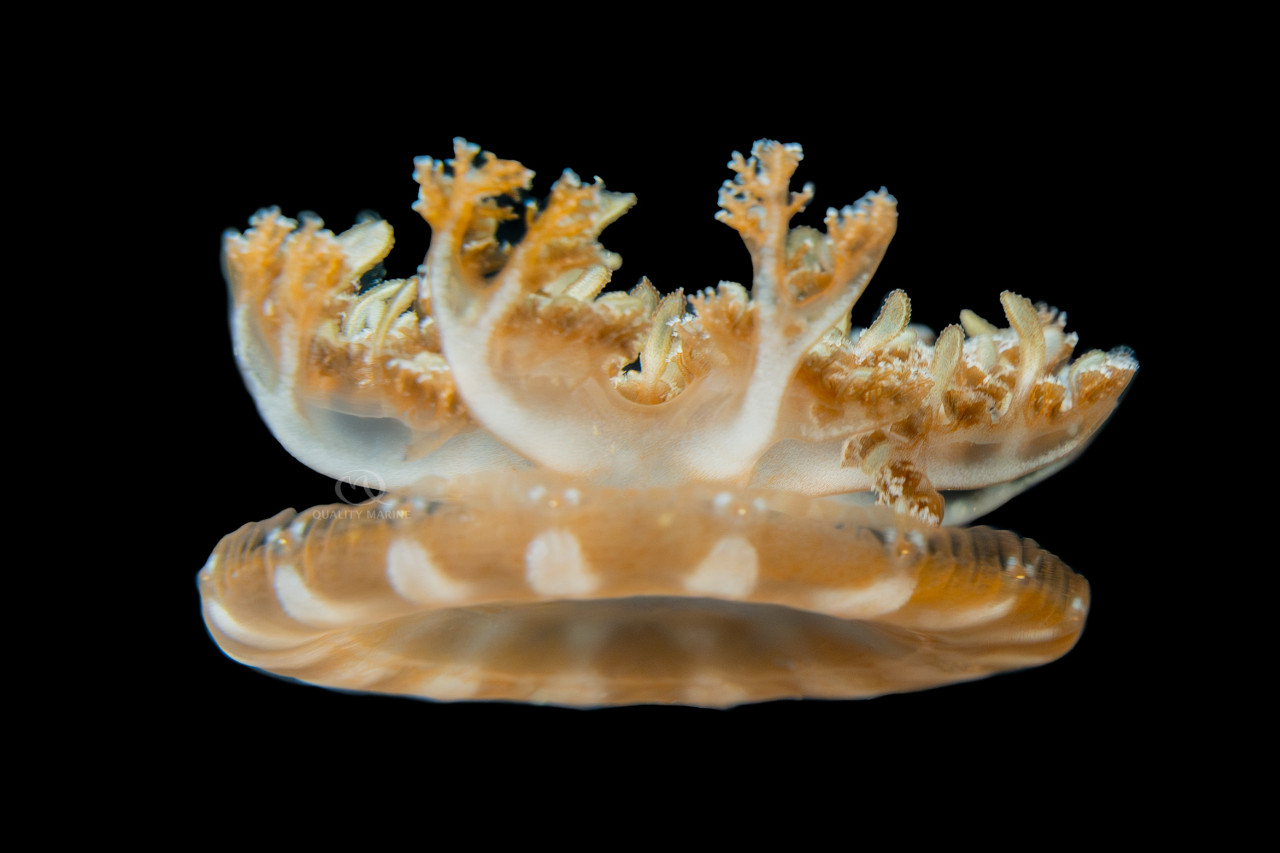
Are you jealous of Jellyfish display? We get it. Jellies are gorgeous to look at and are something completely different when it comes to home aquariums. Most Jellyfish have to be kept in a specialist type of aquarium called a Kreisel. Which are really unique displays and we have an article on keeping them and a couple good Jellyfish choices for them here: https://www.qualitymarine.com/news/keeping-up-with-the-kreisels/
Maybe you don't want a super specialized aquarium, or maybe you have an extra aquarium that you'd like to try something unique with and (like us) Jellyfish have caught your imagination. There is another option for you. We'd like to introduce you to the world of Upside Down Jellyfish of the Cassiopeia genus. These Jellies need to settle out of the aquarium to stay on the bottom most of the time, and well, this is done upside down, making a Kreisel tank the wrong choice. These are absolutely beautiful Jellyfish that are usually green or blue, or some blend of the two, though we do sometimes (rarely) see golden / orange ones. With their bell usually on the bottom of the tank, they extend their intricate tentacles up through the water column trawling the current for food.
Cassiopeia Jellies stay relatively small and will usually be between five and eight inches across their bell at adulthood. These critters don't need much in the way of water volume or depth in their display. You could keep one in as little as ten gallons, and as long as your focus was on increasing area (versus depth) you could keep another one for every ten gallons more. The limiting factor would be how much real estate you have on the bottom of the tank for them to settle into. Lighting for Upside Down Jellyfish needs to be intense. They host photosynthetic zooxanthellae, which help provide energy to the Jelly (another reason why depth in a UDJ tank is counterproductive). Look for lighting that would be appropriate for Tridacna Clams and SPS corals, something in the range of 200 PAR or better. These displays (obviously) don't need to be covered.
Flow needs to be subdued; you want clear (notice we said clear, not clean) water and good filtration, but you also don't want to be blasting and blowing your Jellies around the display. The intakes for the filtration system should be high in the aquarium (as far away from the Jellies as possible) and protected with sponges to prevent anything from getting sucked into them. Some dedicated UDJ keepers also use multiple overflows to minimize the water volume that is going into each one; this is largely unnecessary. Jellyfish of all sorts can be sensitive to having bubbles in the water, and as a result, many public displays for Cassiopeia Jellies utilize undergravel filters set into a reverse flow arrangement. Water is collected by an overflow at the top of the display, it is processed by a skimmer to remove any oils and is returned to the tank through the substrate to help remove any latent bubbles and this also helps keep the substrate clean. Your jellies will do best with at least a trace of ammonia compounds in the system, and some Cassiopeia Jellies will actually need it to reproduce, so biological filtration is not a focus, but regular water changes should be, to ensure you're maintaining balanced water chemistry.
The biggest struggle we see with new Jellyfish keepers is not feeding. Even though Jellies get some of their nutrition through photosynthesis, they still need consistent, supplemental food and this food needs to be small enough for them to digest it. You can target feed them by very gently basting foods at their tentacles. Foods like Gamma Rotifers, and Gamma Copepods are great. Live foods like Nutramar Tigrio, and Nutramar Artemia Nauplii are also ideal. You can help support these foods by using some of the Nutramar Live Algae in the display as well, which will also be a benefit to your Jellies, we recommend Live Phyto TC and / IC as a starting point. Another excellent stand-alone food is Phytotonic from Tropic Marin. Target feeding should happen three times a week or so.
We always offer aquacultured QM Labs Upside Down Jellyfish to all our retail partners, that we aquaculture here in house. While Cassiopeia sp. are very sustainably harvested, aquaculture allows us to give you absolute transparency as to the age and provenance of your aquarium buddy. UDJ have a natural lifespan of about a year, and so if you'd like to try your hand at culturing them at home, it creates a possibility for you to replace your stock over time and adds an element of challenge to what is otherwise a very straightforward aquarium to keep. If you'd rather just keep the Jellies for the beautiful tank they make, we have you covered for new stock. We usually recommend keeping your tank somewhere in the 70s but for reproducing, you'll want to stay on the warmest end of this, or even up to 80/81. The constant availability of nutritious live food will help and the presence of trace levels of ammonia are important to this cycle as well.
Upside Down Jellies should probably be the only thing in the aquarium. They'll combat other Jellyfish, and depending on the coral, they could be a risk for both the coral and / or the Jelly. As far as fish, there are few reasonable choices, all of which could be at risk if the jelly releases stinging cells into the water, which they can do. These Jellies are gorgeous enough to have on their own; think zen when planning these displays, black background, balanced lighting with actinic highlights, bright white (or black?) sand. If that's not enough, (and trust us, it would be) think about some decorative algae like Halimeda, Shaving Brush or Mermaids Fan. We've seen a couple displays over the years that are more like Saltwater Paludariums with Mangroves and these have all been very successful.
As we referenced, Cassiopeia Jellies do have a sting, though most people have little or no reaction to it. There aren't that many aquariums out there that can rival an Upside Down Jellyfish tank for simple coolness. These tanks are easy to keep, look like living art pieces and are something completely different than most aquatic displays. If you're interested, head over to your LFS and ask them specifically for QM Labs Aquacultured Upside Down Jellyfish today!