The Greatest Desktop Aquarium Pair?
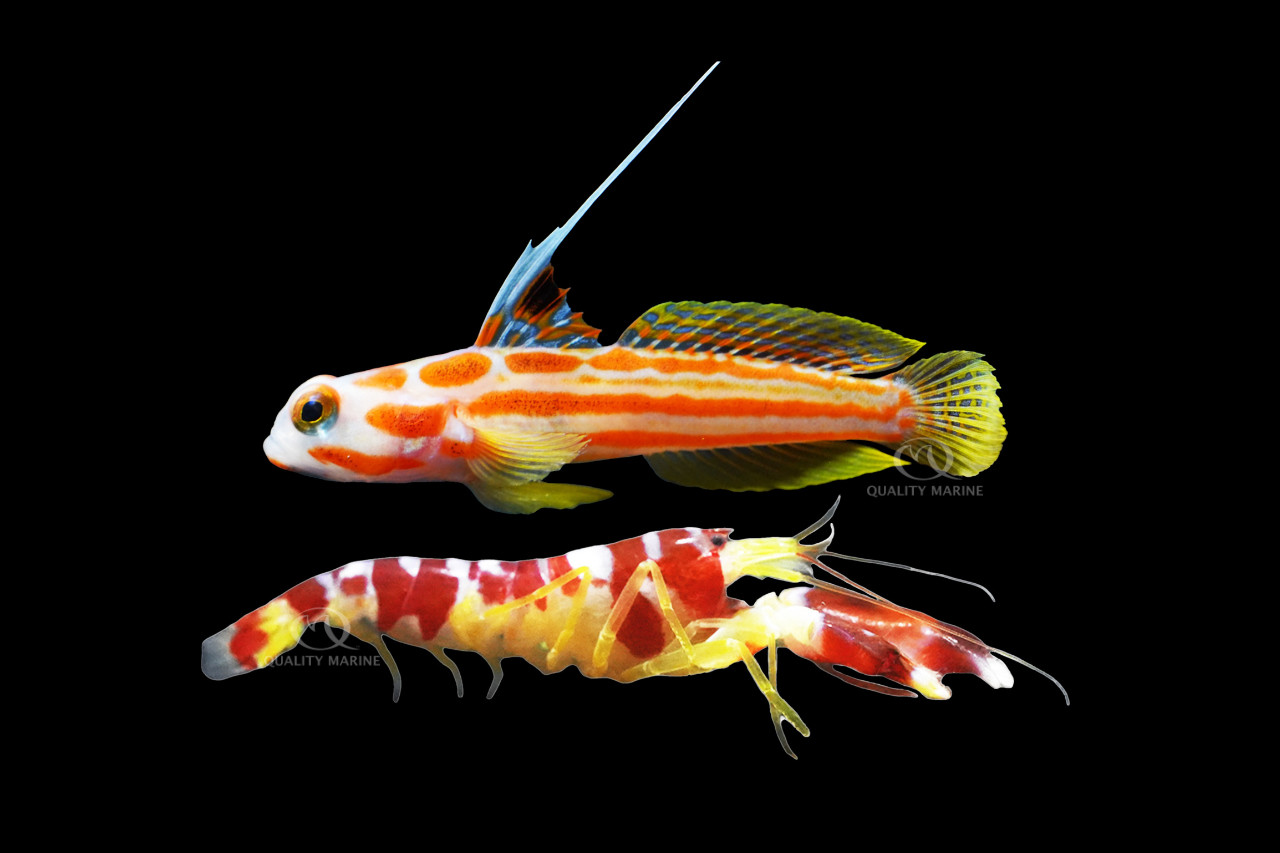
Stonogobiops yasha, better known to most of us as the Yasha Goby, is that fish that quietly becomes an aquarium hobby obsession. Less frequently these gorgeous fish also get called Clown Shrimp Goby, Whiteray Shrimp Goby, and Orange Stripe(d) Shrimp Goby. Regardless, it's a small fish, rarely reaching more than two inches, but it packs an outsized amount of personality into that little pearly-white body with its broken orange stripes, yellow fins, and a first dorsal ray that spikes up like a battlefield flag. Native to sandy slopes and rubble zones on the outer edges of reefs across the Western Pacific, this is a fish built around one of the most genuinely fascinating symbiotic relationships in the entire marine aquarium hobby, and it's worth setting up a tank specifically to let that relationship shine. It may be the ultimate desktop setup.
Roger Williams University's aquacultured Yasha Goby is a captive-bred version of one of the most sought-after nano reef fish in the aquarium hobby. Renowned for its brilliant white body accented with bold red-orange stripes, yellow dorsal fin, and elongated dorsal filament, the Yasha Goby is both beautiful and peaceful. Captive-bred specimens are typically hardier than their wild-caught counterparts, adapt more readily to aquarium life, and support sustainable reef-keeping by reducing pressure on wild populations.
The relationship in question is with a pistol shrimp, most commonly Alpheus randalli, (though any Alpheus will usually work). A. randalli is usually sold as either Candy Cane Shrimp or Randall's Pistol Shrimp. Alpheus genus shrimp are nearly blind and spend their lives excavating and maintaining an elaborate burrow system in the sand. The goby, which has excellent eyesight but absolutely rubbish digging ability, hovers at the entrance and acts as a lookout, darting for cover at the first hint of danger and giving the shrimp just enough warning to retreat as well. It's a genuine partnership, not just proximity, and watching the shrimp's antennae stay in constant contact with the goby's tail while it works is one of those small moments that makes reef keeping worth it. You can absolutely keep a Yasha Goby without a shrimp partner, and it will survive just fine, but it tends to be shyer and spend more time hiding without one. If you have any interest in this species, we encourage you to seek out a single or a pair or add a compatible pistol shrimp early on.
Tank size doesn't need to be dramatic here (start desktop desktop desktop chant.) A 10-to-15-gallon aquarium is a workable minimum for a single goby and shrimp, though we'd lean toward 20 gallons or more if you want to add a pair of gobies or any more stock. Footprint matters more than height with this species, since burrow behavior is entirely a floor-level activity.
Aquascaping is where this species really asks you to think differently than you might for a typical reef display. You need a sand bed, and it needs to be deep enough and fine enough for a pistol shrimp to actually excavate, generally two to three inches of substrate. The depth is key in allowing the Shrimp to dig a burrow that is deep enough for the Goby. You'll need sand that is 1.5 times as deep as the Goby is long. Ideally this is a mixed grain sand, which allows for a much more stable tunnel construction than super fine, oolitic or sugar sands. Place a piece of live rock or two right at the edge of that sand bed, but firmly on the bottom of the aquarium. Ideally these rocks might feature a bit of an overhang or crevice near the base, since this gives the shrimp a structural anchor to build around and gives the Goby a bolthole to disappear into. Resist the urge to bury that transition zone under a dense reef structure. Open sight lines near the burrow entrance matter to this pair, and a heavily obstructed view will make both animals more skittish. Beyond that functional requirement, the rest of your rockwork can be as elaborate as you like. Yasha Gobies are reef safe and aren't going to bother corals.
Feeding a Yasha Goby is straightforward since this is a carnivore that responds well to a varied, meaty diet, and honestly the shrimp benefits from the same feedings. We like a rotation built around Gamma's frozen line, particularly Mysis Shrimp and enriched Brine Shrimp, both of which are sized well for this fish's small mouth and packed with the kind of nutrition that keeps colors sharp. Gamma's Cyclop-eeze is another excellent addition, especially useful for encouraging a shy or newly introduced Goby to start eating confidently. For a daily staple that both the goby and any other small reef fish in the tank can graze on, Nutramar's Marine Complete is a food worth building your feeding routine around, since they're formulated with genuinely balanced nutrition rather than just being filler between frozen feedings. The one challenge in feeding Yasha Gobies is that they are initially shy. They tend to feed right at the mouth of their burrow rather than chasing food through the water column, so you may need to target feed them initially (a baster is a great tool here,) and it won't ever hurt to keep doing it, which helps make sure both the Goby and the Shrimp get enough food, especially in displays that feature other fish (which may be more aggressive eaters.)
Speaking of tankmates, this is a peaceful species that does best surrounded by equally peaceful, small reef fish. We love a school of Cardinals over a pair of Yashas. Other small Gobies, Firefish, small Dartfish, and small, peaceful Wrasses (like a harem of Fairy Wrasses) all make excellent companions, and a well-stocked reef community can absolutely include a Yasha Goby without any territorial drama. What you want to avoid is anything boisterous or aggressive enough to bully your Goby away from its burrow entrance, since a stressed goby that won't emerge is a Goby that stops doing the thing that makes it special in the first place. Larger, food-competitive fish can also be an issue simply by outcompeting the Goby at feeding time, so keep that in mind when building out your stocking list. As for invertebrates, this species is reef safe and generally ignores corals and sessile invertebrates entirely. Snails and hermit crabs are fine tankmates, though we'd be cautious about particularly aggressive crab species that might raid a shrimp burrow, and you'll want to think twice before adding anything predatory enough to threaten a pistol shrimp of this size.
Roger Williams University's aquacultured Yasha Goby is an outstanding choice for nano and larger reef aquariums. Its striking coloration, peaceful nature, and improved hardiness make it an ideal fish for hobbyists looking to support sustainable aquaculture while enjoying one of the reef hobby's most elegant goby species.
The Yasha Goby is proof that you don't need a big, dramatic fish to build a genuinely captivating reef display. Set up that sand and rock interface thoughtfully, pair it with a pistol shrimp if you can find one, keep the surrounding community calm, and you'll have a display that rewards patient observation more than almost anything else in the hobby. Honestly, go find yourself a pair from a Quality Marine retail partner and give those critters the burrow they deserve. You just might have the coolest desktop display ever conceived.