The Amazing Case for Armitage Angels
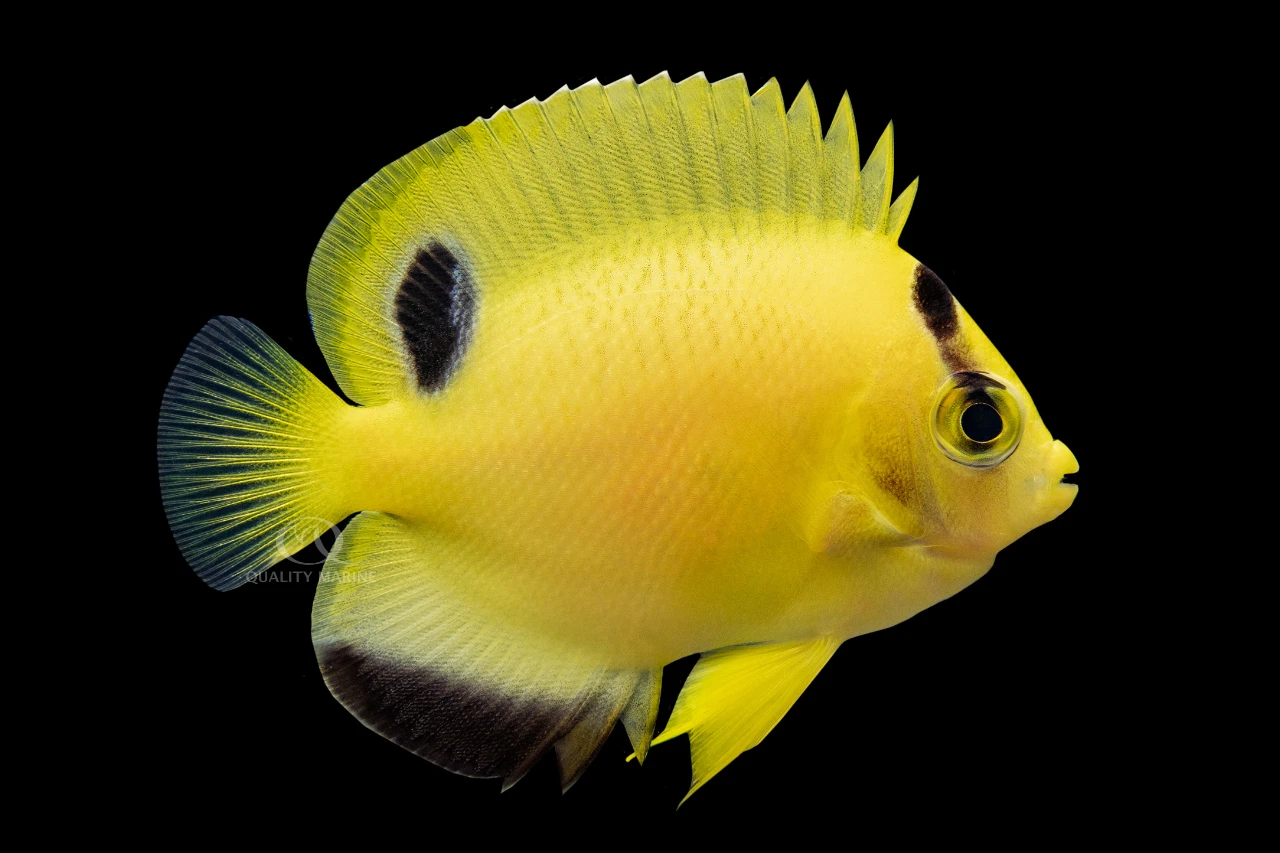
Apolemichthys armitagei goes by a handful of names depending on who you ask. Armitage Angelfish is the one we hear most often, and it's the one we use here at Quality Marine. Armitage's Angelfish is just plain weird, don't do it. All of them honor the person the species was named after, and all of them describe the same fish: a compact, handsome angel with a creamy yellow body, a dark spot on its flank, and a pale blue wash around the eye. The scientific name is the one that never changes, which makes it the safest bet when you're hunting for one.
Interestingly, that scientific name is currently valid according to fishbase and WORMS. Conversely, there is growing consensus that this species might actually be a hybrid of Apolemichthys trimaculatus and Apolemichthys xanthurus. Hybrids are more common in marine Angelfish than they are in many other marine species, so this wouldn't be too surprising. As of the writing of this article, this is treated as a distinct species by the various regulatory bodies that govern the international movement of marine species, and so we're bound to keep it listed as such.
These fish come from the Indian Ocean, where they live around coral reefs and rocky structure. For those of us lucky enough to get our hands on an Armitage, this is a good place to start when thinking about a display for them. Angelfish in this genus are reef dwellers that spend their days grazing and picking over rockwork, swimming in and out of crevices, and keeping a wary eye on the open water. They aren't the shy wallflowers some people assume, but they do appreciate having somewhere (or better yet, many somewheres) to retreat to. If you can picture a busy, rock-heavy reef wall, you've got the right idea.
Armitage's Angels stay pretty small, especially when compared to their Pomacanthus cousins, topping out at around six (maybe seven) inches. That makes them a vastly more approachable angelfish for most hobbyists, but "small angel" doesn't equate directly to "small tank." These fish swim constantly, graze constantly, and produce plenty of waste for their size. We suggest a minimum of 125 gallons, and something around 180 - 225 gallons would be even better. Length matters more than height here, since they'll patrol the entire display and want room to stretch their fins. They'll often do fine in a smaller aquarium at first, but it's best to plan for the long haul, because a cramped angelfish tends to become a grumpy angelfish.
Armitage Angels spend a huge part of their day grazing on rock surfaces, so plenty of live rock gives them both a workplace and a playground. Build in lots of caves, arches, and swim-throughs, while still leaving some open water so they can cruise. A tall, open aquascape with a few big, deliberate structures is going to work better than the old school “pile of rock crammed against the back glass,” since it gives the fish more hiding places, clear lanes to patrol and plenty of surface area to graze. Substrate is decorative for angels, and they're good candidates for bare bottom tanks. Choose whatever looks best to you. Live Rock with a mature layer of algae and microfauna is a real asset, since it gives a newly arrived fish something to nibble on from day one.
When it comes to water chemistry for Armitage Angels, look for stability above all else. Specific gravity anywhere between 1.021 and 1.026 as long as it doesn't move. Temperature should be somewhere in the 75 to 79 (F, obviously) range. Keep pH between 8.1 and 8.4, and alkalinity in the standard reef range of around 8 to 11 dKH. Ammonia and nitrite should always be zero, and nitrate should be kept low, ideally under 5 ppm. Angelfish are hardy once they're eating and settled, but they don't enjoy swings. A mature, well-established aquarium is the right home for one, and a brand-new tank that's still cycling is not. Strong flow and strong filtration go a long way too, and we like to see a healthy turnover, 20x tank volume or better, to help keeps oxygen high and detritus suspended long enough to be removed. Don't skimp on water changes, either. Grazers eat all day, and what goes in has to come out.
Angelfish are grazers by nature, and the best captive diets try to mimic that. We lean heavily on Nutramar Algae and Color Boost Shots. Because a shot can be stuck right to the glass or a rock, the angel gets to graze on it the way it would in the wild, picking away at it over time instead of gulping down a meal and being done. That grazing opportunity utilizes natural feeding triggers for newly acclimating fish, giving them something that looks and feels like a natural food source. We also use Nutramar Ogo and Nori in clips, and we hydrate the Nori in Nutramar Feeding Boost Spray before it goes into the tank, which boosts its nutritive value and helps it hold together longer.
For the meaty side of the menu, we offer a rotation of thawed Gamma foods. Brine Plus Spirulina and Brine Plus Omega 3 are regulars, and Mysis, Tubifex, and bloodworms are usually taken with enthusiasm. Variety is the whole point. Angelfish that get a mix of algae, sponge-like foods, and meaty offerings tend to color up better, hold their weight, and show less interest in picking at the corals around them. To that end we also utilize a portion of the Gamma Vegetarian Diet for them. Small fish do best on a couple of feedings a day. As they settle in, you could feasibly cut back but remember that a grazer is happiest when food is available throughout the day, so the shots and clips are a great way to bridge the gaps between regular meals.
Compatibility needs some honesty. Like most of the angelfish family, Apolemichthys have a taste for certain things that reef keeping enthusiasts would prefer they leave alone. They're considered a moderate risk around corals, and individual fish vary a lot. Some will ignore everything, while others will take a bite out of a zoanthid colony or a prized large polyp stony coral. Soft corals and some hardier LPS are the usual starting point if you want to try your luck, but there are no guarantees, and the only coral that is 100 percent safe is the one in someone else's tank. Avoid keeping the Angel with clams, sponges, and tunicates, which are all natural food items for this group and will almost certainly be eaten. If you're dead set on trying your Armitage with some corals, keep in mind that a well-fed Armitage's Angel is less likely to go looking for more food.
On the subject of other fish, Armitage's Angels are generally good citizens compared to some of their larger relatives, but they can be territorial with other angelfish, especially similar-looking ones, and particularly in smaller aquariums. If you want to keep more than one angel, make sure the tank is large, introduce them carefully (and preferably all at once), change up the rockwork before you add them and always and have a backup plan. Most other peaceful to semi-aggressive reef fish are fair game, including Tangs, Wrasses, Anthias, Clowns and some Damsels, provided the tank has room for everyone. Avoid very sedentary or timid tankmates that could be picked on.
If you're looking for an Angelfish with serious visual impact that doesn't demand a giant display, the Armitage Angelfish deserves a spot on your shortlist. It's attractive, active, and endlessly entertaining to watch as it works its way across the rockwork. Give it room, a good variety at feeding time, and a stable, mature home, and you'll have a show stealing fish that makes the whole tank feel more alive. Ask your Local Fish Store about getting you one from Quality Marine today!