Sweet Severn's
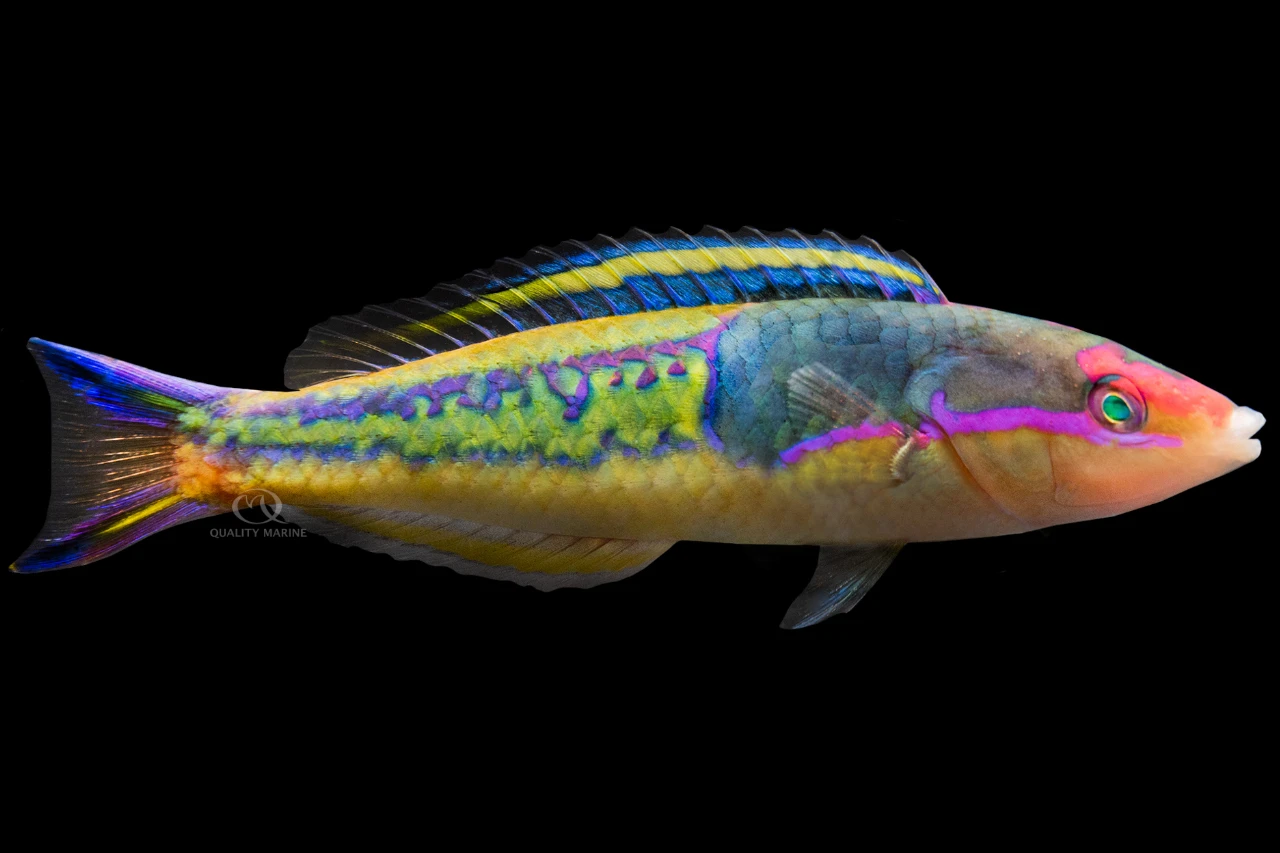
The entire genus known as Pseudojuloides does not get near enough love. There are only a few species that make it into the aquarium trade with any regularity, and fewer still that are once-in-a-blue-moon opportunities at your LFS. All of them are excellent, gorgeous, (mostly reef safe) fish that are size appropriate for aquariums that are within the reach of most hobbyists.
Pseudojuloides severnsi is one of these blue moon specimens that you should be on the lookout for. While it is still pretty rare, they're more common than they were said 10 years ago, and this makes sense as the species was only described in 2000. It was named for Mike Severns, the man who first brought attention to it, and showed it to the venerable Dr. Jack Randall. More commonly this fish has a few names you might see displayed in your LFS. Here at QM we call it the Decolores Wrasse, it is frequently called Severn's (Pencil) Wrasse and we've also seen it labeled the Royal Pencil Wrasse; a less common but very fitting name with the brilliant yellow, gorgeous blue and royal purple coloration that adorns the adult male of the species. On that note, the females and juveniles are usually a soft pastel, orange-ish pink.
Decolores Wrasses are small fish (like the rest of the genus) usually less than four inches or so at adulthood and while they are active, they don't need a massive amount of space. You could keep a single individual in a 55-gallon aquarium or a pair in a 75 quite easily. They can bolt when surprised, and so it's a good idea for this tank to have a lid. They also need a sand bed of fine-grained sand. It doesn't need to be sugar or oolitic fine, but it shouldn't be course, or mixed grain. Ideally this should be at least an inch or two deep because they'll hide in it when spooked, and sleep in it overnight. The aquascape should offer a good balance of open sand bed and complex rockwork for the Wrasse(s) to swim through, hide among, and forage on. Lighting is immaterial, though the fish will absolutely glow if you have a strong actinic component to your setup.
Contrary to the common “knowledge” these fish are excellent reef tank additions. They're very unlikely to bother any of your corals and will leave most of your other inverts alone as well. Be cautious about having them in displays that feature clams as Decolores might be tempted to take nips of the clam mantles. Really small shrimp like some of those in the Periclimenes genus might also be in danger of getting eaten. They are quite peaceful with other fish as well and are generally pretty easy to pair on your own if you can find a male and a female. The only fish we'd caution against are large predators like Groupers who could turn the Decolores Pencils into a meal, and really aggressive fish that might bully your Wrasses during feeding time.
On the topic of feeding time, these fish like to eat buffet style. A little at a time, but all the time. They can also be somewhat shy when first added to the tank, so if they hide when you approach, feed with the lights in the aquarium on, but the room lighting off, which will hide your presence at the tank side somewhat (dark clothing helps too). Here we feed them a mix of meaty foods from Gamma. Their wild diet is almost all invertebrates, so we lean heavily into that. The mix changes, but includes items like Mysis, Brine Plus Garlic, Brine Plus Omega 3, Bloodworms, Copepods (and Copepods plus Garlic), Finely Chopped Mussel and Prawn round it out. We ALWAYS feed this mix with a dose of Nutramar Marine Complete Pellets and sometimes Shots. Shots let the Decolores graze as they normally would, and introducing the pellets with the meaty foods is all about training them to recognize the pellets as food. Once you get them on pellets, you can use an auto-feeder to get them a couple meals a day that you don't have to be present for. Here we feed them two to three times a day, and that's enough, but for long term, at home, you could bump that up as much as you want, as long as you fed less per feeding time; four, even five meals a day wouldn't be a bad idea. If you have trouble getting them to stop hiding during mealtimes, start with some live food like the Artemia from Nutramar. These come gut loaded with Nutramar IC live microalage and are basically irresistible to carnivore fish.
Pseudojuliodes severnsi aren't really all that picky about water chemistry. The temp should be in the low to mid 70s, the specific gravity can be anywhere from 1.020 to 1.026, and the pH should be somewhere in the 8.0 – 8.4 range and all of these should be really stable. This is one of the reasons we recommend having them in a mature aquarium setup. The other reason is that mature aquariums usually have better populations of micro inverts for the Pencil Wrasse to hunt, and this is also a positive for a fish that would happily eat small bites all day long. To that end, a refugium isn’t bad idea either. Nitrates should never get above 5ppm (nitrates higher than that are going to give you other problems anyway).
Is there a catch to keeping this stunning fish? They can be sensitive to shipping stress, so you want to buy wrasses in this group from a Local Fish Store and you want that local fish store to get one from us and our Short Supply Chains vendors. A healthy fish with its feeding triggers intact will do quite well in a mature aquarium. Have you been looking for something GORGEOUS to be the anchor of your display that doesn't get too big? Something, perhaps, with a dash of rarity panache? It's time you asked your LFS for a pair of Decolores Pencil Wrasses from Quality Marine today!