Sometimes, More IS More
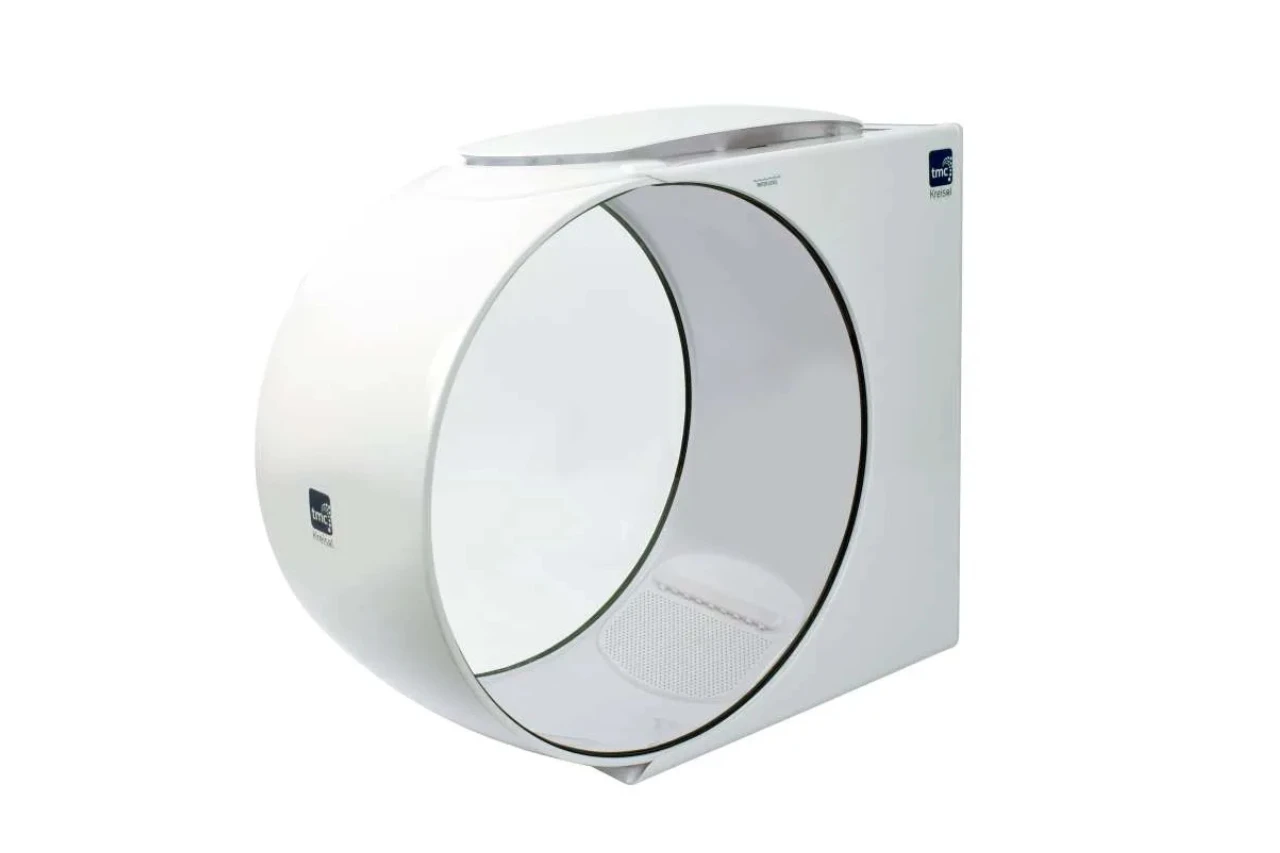
Jellyfish are a bit of a paradox. They are elegant, drifting, almost impossibly graceful animals that also happen to be about 95 percent water and entirely lacking a brain. For decades, keeping them at home was a pipe dream, because jellies just don’t swim well enough to avoid the filtration in a conventional aquarium, and sooner or later every design anyone came up with ended up pulling them in. That changed in the late 1960s, when a German biologist named Wolf Greve needed to get Arctic jellyfish back to his lab alive and invented the kreisel. The name is German for “spinning top,” and the idea is simple and brilliant: move the water in a gentle circle, and the jellies move with it instead of fighting it. We’re pretty sure Greve had no idea he was about to change what a desktop could look like.
The 25 is the largest of TMC's Kreisel tanks range, sitting above the 10 and the 15. It. Is. Glorious. The display holds 25 liters (6.6 US gallons) and measures approximately 18.8 × 16.1 × 8.1 inches, which keeps the footprint small enough for a desk, a reception counter, or even a kitchen island. Inside, a spray bar powered by an energy-efficient 5-watt DC pump creates a smooth, laminar current at up to 300 liters per hour (roughly 80gph). Water travels in a gentle gyre that carries your jellies and their food toward open water in the middle of the display, while the filtration sits hidden outside the flow pattern. Because a jelly would have to swim strongly across that current to reach the intake, and jellies simply can’t, they stay safely out of trouble. The filtration is built right into the unit, so there is no external canister and no tangle of hoses, just a tidy, self-contained system. It is built from acrylic and ABS, and the integrated 4-watt color-changing LED has a touch sensor for switching between modes, plus an included silicone sleeve for a softer, more subtle glow. A chiller connection is also built in for temperature-sensitive species, though keep in mind that additional fittings and parts may be needed depending on your installation. In the box you’ll find the tank, filtration, lighting, pump, power supply, light sleeve, a leveling mat, and a cleaning pad and cloth.
The Kreisel 25 is suited to a nice range of jellies. Moon jellies (Aurelia aurita) are one of the most widespread jellyfish in the world’s oceans, absent only from the Arctic, and that adaptability to a wide range of temperatures makes them an easy-going choice for beginners. With the extra volume of the 25, they have the elbow room that slightly larger specimens appreciate. Blue blubber jellies are another great fit, everything coming in from nearly pure white to a navy so dark it looks black, with the occasional deep reddish brown thrown in, and they have a quick, staccato pulse that is a joy to watch. And then there are Violet Jellies (Mastigia sp.), which are the staff favorite here. They are intricately ornate, stay quite small (one to four inches) and are the same genus that made Jellyfish Lake in Palau famous. They reproduce readily in captivity, so aquacultured specimens are often available, and most have lost their sting. As with any aquatic critter, ask your retailer about expected adult size so you know what you’re signing up for. Whichever you choose, always ask for sustainably harvested or aquacultured jellies from Quality Marine.
Setting up your Kreisel 25 starts with picking the right spot. Choose a location without direct natural sunlight to keep algae in check and make sure there’s an outlet nearby. Place the leveling mat, assemble the tank following the included instructions, rinse your filter media well, and install the media and filter pads. Then it’s time for water. Use a quality salt mix like Tropic Marin and make sure it is fully mixed before it goes into the system (and every time you do a water change after that). Like any aquarium, a kreisel needs to be cycled before it gets any residents, and we strongly recommend kick-starting that process with Dr. Tim’s One and Only. We’ve got a full guide to cycling at https://www.qualitymarine.com/news/first-timer-cycling-your-new-aquarium/
Adding jellyfish requires one very important change to your usual routine: jellyfish can never be exposed to air. We recommend drip acclimation, but when it’s time to move them, use a ladle to scoop the jelly from its bag and lower it gently into the tank. Warm the ladle in the tank water first so it isn’t a cold surprise. Then step back and enjoy.
Feeding is refreshingly simple, because jellies don’t have a feeding trigger like fish do. If an acceptable morsel touches their stinging cells, they eat it, and the gyre delivers food right where they need it. For jellies this size, we reach for Gamma. Gamma Brine plus Spirulina, Brine plus Omega, Copepods and Rotifers are all excellent choices, and larger jellies can handle Gamma Mysis. Thaw about a quarter to a half of a blister pack, let it come up to tank temperature, and pour it directly into the tank. Don’t target feed with a baster, as you can really easily damage the jelly’s delicate bell this way. If food is still floating around or has settled after about 30 minutes, remove what you can with a baster or pipette, and feed a little less the next day. Feed once per day, and don’t worry too much if you miss a day or two. Overfeeding is the thing to avoid, because uneaten food breaks down into nitrogen that stresses your jellies and fuels nuisance algae.
Maintenance is easy and will feel familiar to anyone who has kept a marine tank. Do regular water changes; start with about 10 to 15 percent weekly (a gallon would be a bit more than 16%) and increase the volume if you see nutrient spikes or pH swings. This is a small aquarium and water quality in small tanks can vary quickly, so test a lot! We suggest testing daily until you get really consistent results with your set feeding schedule, and then you can back off a little. Use the included cleaning pad and cloth to keep the glass clear, and top off any evaporation loss with clean, de-chlorinated (and correct temperature) fresh water. Keep the tank free of decorations, since anything in there is just something for a jelly to get hung up on, and watch for bubbles, which jellies don’t tolerate. That minimalism is part of the charm; a kreisel is about as zen as an aquarium gets.
Some of you marine fish enthusiasts are thinking that there’s a second life this display could lead and you're not wrong. Greve’s design has been adapted over the years for other uses, and one of the most interesting is raising fish through their larval period. Newly hatched marine fish are tiny, fragile, and not great swimmers either, and they are very much at the mercy of the corners, hard flow, and intakes in an ordinary aquarium. The same gentle gyre that keeps jellies safe can keep larvae drifting in open water while concentrating their food in the center of the tank. There are no sharp angles to bump into and no decorations to snag on, and the 25 liters of volume is a convenient size. The chiller connection and the adjustable LED are bonuses for breeders who want to dial in temperature and lighting. We encourage would be breeders to trial it carefully if this is your intended use case. Then spam us with pictures / videos and BRAG if it works!
Whether you’re looking for a showpiece on your desk, a living centerpiece for your lobby, or a nursery for your next batch of fish, the Kreisel 25 is a fantastic way into a corner of the hobby that used to belong only to public aquariums. Head to your local fish store, ask them to get you a TMC Kreisel 25, and since they're already ordering from Quality Marine, they might as well get you some sustainably harvested or aquacultured Jellies from us too!