Praising Pomacanthus xanthometopon 'Till We're Blue in the Face
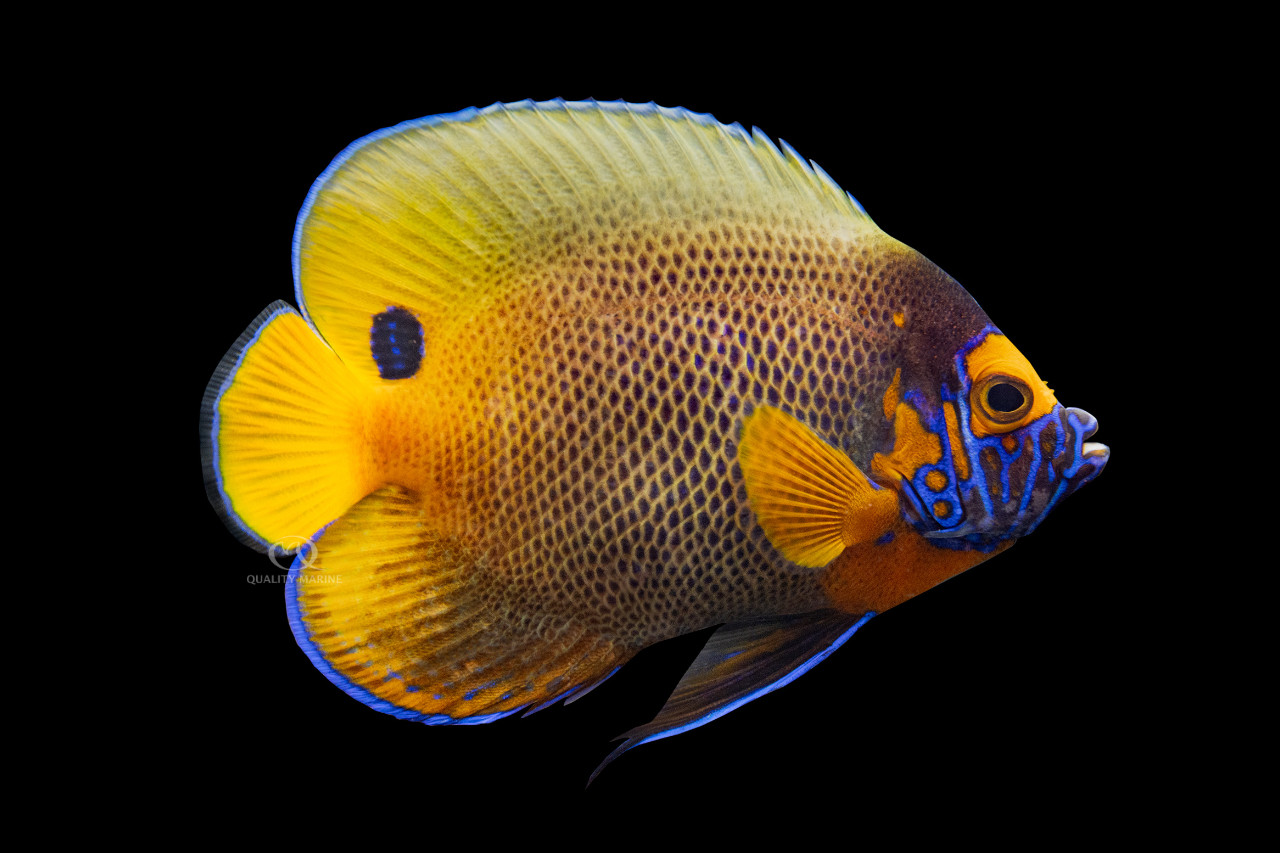
Blue Face Angelfish are also very commonly called Yellow Face Angelfish, and this makes no sense to any of us around here. The third (and much less common) name you might see is Yellow Masked Angelfish and this one does make sense when you see the (obviously) blue-faced fish with a yellow raccoon mask on. They're most accurately described by their scientific name, Pomacanthus xanthometopon.
They have a fairly wide range, spreading over much of the Indo-Pacific, but they like a fairly specific habitat, and are nearly always found in fairly shallow water near coral reefs. They're shy and like a bit of cover. When planning your display for them, you should mimic the cover part; these fish will really love having plenty of caves and swim-throughs for them to utilize. The ample rockwork will also give them more surfaces to graze, which is a borderline obsessive activity for most Angels. Bluefaces will also need some open space for swimming. Substrate is purely decorative when it comes to Angelfish of all types, so make that aesthetic choice, or opt for none at all. Flow should be strong, and so should filtration; we're looking for a 20x turnover of the tank volume for both. Lastly, in regard to the display, Pomacanthus xanthometopon can get quite large for an aquarium fish. The biggest one on record is almost 15 inches long, though a much more common adult size is more like 12-13 inches. Regardless, this is going to need a big tank, our suggestion is 220 gallons or more, in the six-foot-long configuration. This is not a super-fast growing fish, and could be kept in a smaller aquarium initially, but just go big and be done with it!
The next part of that display is going to be all about compatibility. Like all Pomacanthus genus Angels, Blue Faces are high risk with most corals. They seem to prefer different corals as they age, with younger ones seemingly preferring SPS corals, and larger specimens more frequently opting for polyps like zoanthids. They're aren't any rules here, each individual fish can have an individual appetite preference. The only coral that is totally safe is one that is in a different fish tank. That being said, if you're dead set on trying to have a Blue Face Angel with some corals, certain adult individuals will often ignore mushroom corals and a few other softies, so that might be a good place to start. Fishwise, you have many options to share a display. Pomacanthus Angels will largely ignore most other fish, with the exception of other large (Pomacanthus and some Holacanthus) Angels. They aren't good matches for really sedentary fish like Eels and Sharks, which they might pick on to see if they're made out of tasty stuff. They will almost always eat clams, sponges and shrimp if they can.
The other way to help your success rate with corals is through heavy feeding. You're going to want to do some algae feeding, and for this job we lean on Nutramar Ogo and Nori in clips. We hydrate the Nori in Nutramar Feeding Boost Spray before adding to the tank which increases it nutritive value and also seems to keep it together better. We also lean heavily on the Nutramar Algae and Color Boost Shots, which we can stick to the glass in the aquarium, allowing the Angelfish to graze on it, using the animal's natural feeding behavior to help it acclimate to an appropriate captive diet. We also like to feed a variety of thawed meaty foods from Gamma like the Brine Plus Spirulina and Brine Plus Omega 3. They'll usually greedily accept items like Mysis, Tubifex, Bloodworms and when larger, Whole Cockle (or Cockle in Shell) and Whole Mussel. Small specimens should get fed a couple times a day, larger ones will be fine with a single feeding (though more never hurts as long as the total volume of food stays the same). You can also feed your Angel some live marine sponge if your local aquarium store stocks it, though this can be an expensive undertaking.
Blue Face Angelfish are quite hardy once acclimated and eating. They're not going to be picky about water chemistry. Specific gravity between 1.020 and 1.026 will be fine as long as it is stable. Temperature should be somewhere between 70 and 78 (F obv) and pH should also be stable somewhere in the 8.0-8.4 range. Stability is your key here, and so these fish should always be added to well established (and large) aquariums. Water quality wise, don't skimp on the water changes. Big fish have big appetites and make big waste. Keep nitrates under 5ppm, and 2ppm would be a much better goal. Nitrates and Ammonia should always be zero.
All Pomacanthus Angels have spines on their cheeks, and these spines can get caught in fine meshed nets, so avoid using them. Blue Face Angels are among the most spectacular of all fish you could have in an aquarium, on a scale from 1-7, they have a stun factor of 12. On top of this, juvenile fish (which are cool looking to start with) go through a mind-blowing color transformation on their path to adulthood. Absolute fire. If you're looking for the ultimate showpiece aquarium fish, Pomacanthus xanthometopon deserves some serious consideration. Ask your Local Fish Store about getting you one from Quality Marine today!