Nothing Pterrible about Ptereleotris evides
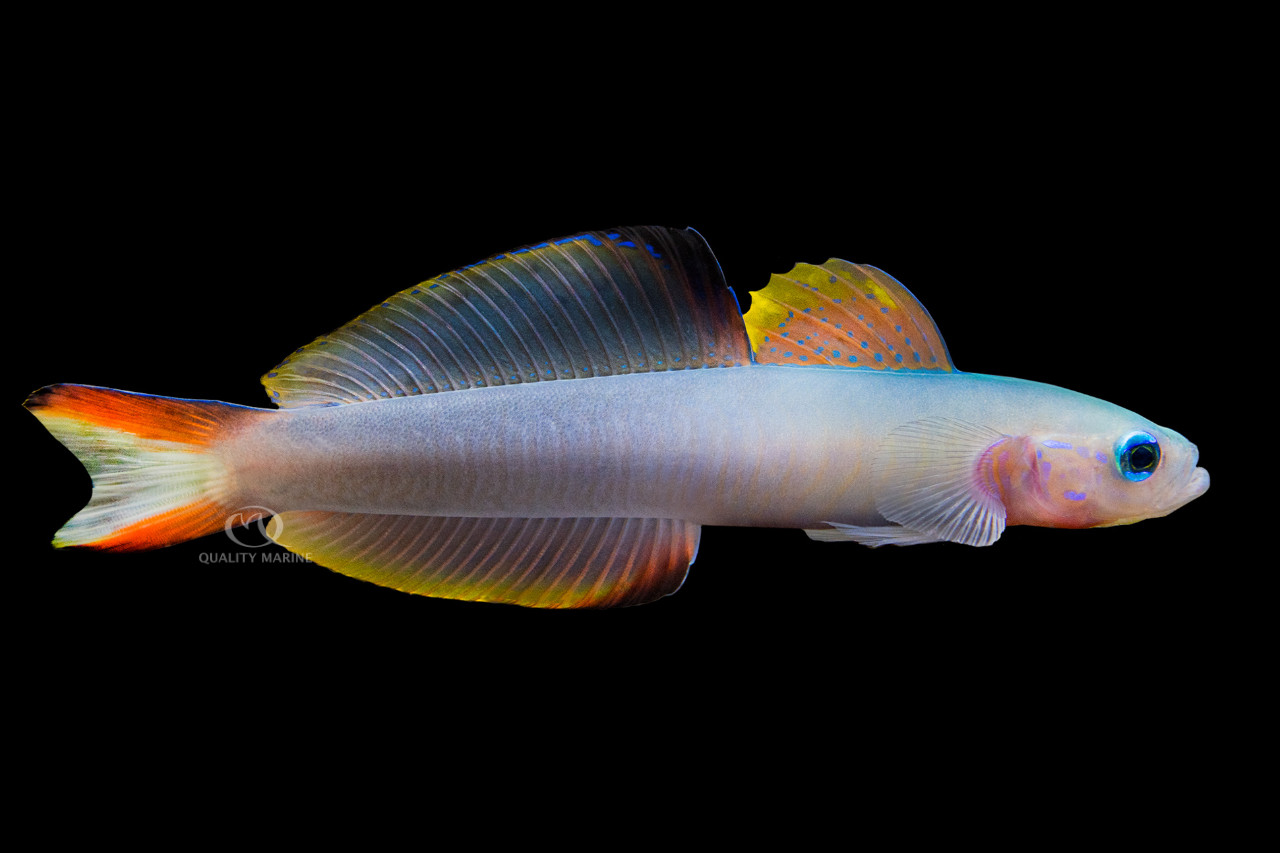
The Scissortail Goby is today's entry in the lexicon of Highly Underrated Fish. They are gorgeous, peaceful, fun to watch and easy to keep once acclimated; it's a shame more aquarium enthusiasts don't keep them. Scientifically, this fish is called Ptereleotris evides. Commonly it has a few more names, the most common of which is likely Blackfin Dartfish. Depending on where you are in the world, you might also hear it referred to as Arrow Dartgoby, Spottail Gudgeon, Two Tone Dartfish, and one of our favorite names comes from Australia where this fish is frequently called the Sailfin Hovergoby.
This name is super appropriate, both in how it looks, with their large beautiful dorsal fins and cartoonishly huge adipose & anal fins and also in their behavior. Once they are comfortable in their surroundings, they'll spend most of their awake hours hovering above the bottom, usually near cover. It’s beautiful to watch, and something totally different than what most fish bring to the home aquarium. Scissortails can be kept singly, but they also do well as mated pairs or in groups of five or more; the hovering activity will be more dramatic and more frequent the more fish there are. They also do well with other peaceful fish, Cardinals make perfect tankmates, as do peaceful Clownfish, Fairy wrasses, Firefish and others. Some Blennies will do very well with Scissortails, you want one that looks dramatically different, so they don't get territorial with the Goby. Certainly, avoid all aggressive fish.
Even large and very active fish (even if quite peaceful) aren't a great match as their activity will scare the Scissors into hiding; if an aquarist is going to have a problem with a Scissortail Goby, it's going to be them hiding during meal time, so we want to do everything we can to make sure that doesn't happen. Keeping the lighting lower than usual for the first few days is a good idea and initially feeding them from a darkened room also helps you hide from them. Once they realize your presence means mealtime, they'll stop hiding. They're planktivores, and so they are quite used to eating anything meaty that floats past. As long as they are out and about, getting them to eat isn't usually an issue! In house, we feed them a mix of meaty foods from Gamma. Bite size is an important consideration with these fish. We like the Brine Plus products (Garlic, Omega & Spirulina) as well as other smallish bites like Mysis, Copepods, Rotifers, Tubifex, even Mini Bloodworms. We also feed some of the new Nutramar Complete Crumbles, which offers a variety of food sizes to your fish, depending on how you handle the food. You should feed them at least three times a day. Once the fish are bigger than three inches or so, they'll be plenty large enough to eat the Nutramar Pellets, which makes multiple feedings so much easier, while really ensuring your fish get a perfect diet.
Another thing that makes Ptereleotris evides feel safe in the home aquarium is having lots and lots of choices for hiding places. They won't dig their own burrows, so you have to give them enough rocks to hide within / under so that there is always somewhere to escape to. They'd love the old school saltwater displays that looked like a solid wall of rock (man, we've come so far, it's crazy). We digress. Lots of rock, lots of holes and whether your display has sand or not will really matter to them. These fish will dart away from danger (the source of another one of their excellent names) and as a result, can (will) easily jump out of an uncovered aquarium. Use a cover they don't fit through. This is a shallow water fish, and can be kept under bright lighting, but acclimate them to this condition slowly. They'll LOVE a ton of flow, the more the better as this emulates the reef edges that are their wild home. They can get up to about five inches long, and most adults will hit at least four inches, but they don't need a ton of space per fish. A single or a pair could be happily kept in 40-gallon tank.
Water quality and chemistry is in line with what most aquarium fish do well in. Specific gravity can be anywhere from 1.020 – 1.026, the pH should be between 8.0 and 8.4, and the temperature between 72 and 78. They aren't specifically very susceptible to nitrogen-based pollutants, and we always encourage people to keep their nitrates under 5ppm (and usually lower) because of the other headaches it can cause.
There are lots of Dartfish available to the home hobbyist, and they're all pretty. Some are difficult to keep, some are outlandishly expensive and with the Scissortail Dartfish, you get a fish that is neither. This fish is approachable cost wise, isn't hard to keep, but can go ten toes in beauty wise with pretty much all the other fish in its grouping. There isn't a fish on the planet that is more “reef safe” than Ptereleotris evides either. If you're looking for a really cool centerpiece fish for a small reef system, or a group of accent fish for a larger, peaceful community tank, Scissortail Gobies are about as cool as you can get, which is why we don't hesitate to call them a Highly Underrated Fish. Stop by your LFS and ask them about getting you a group of them from Quality Marine today!