No Rough on This Diamond
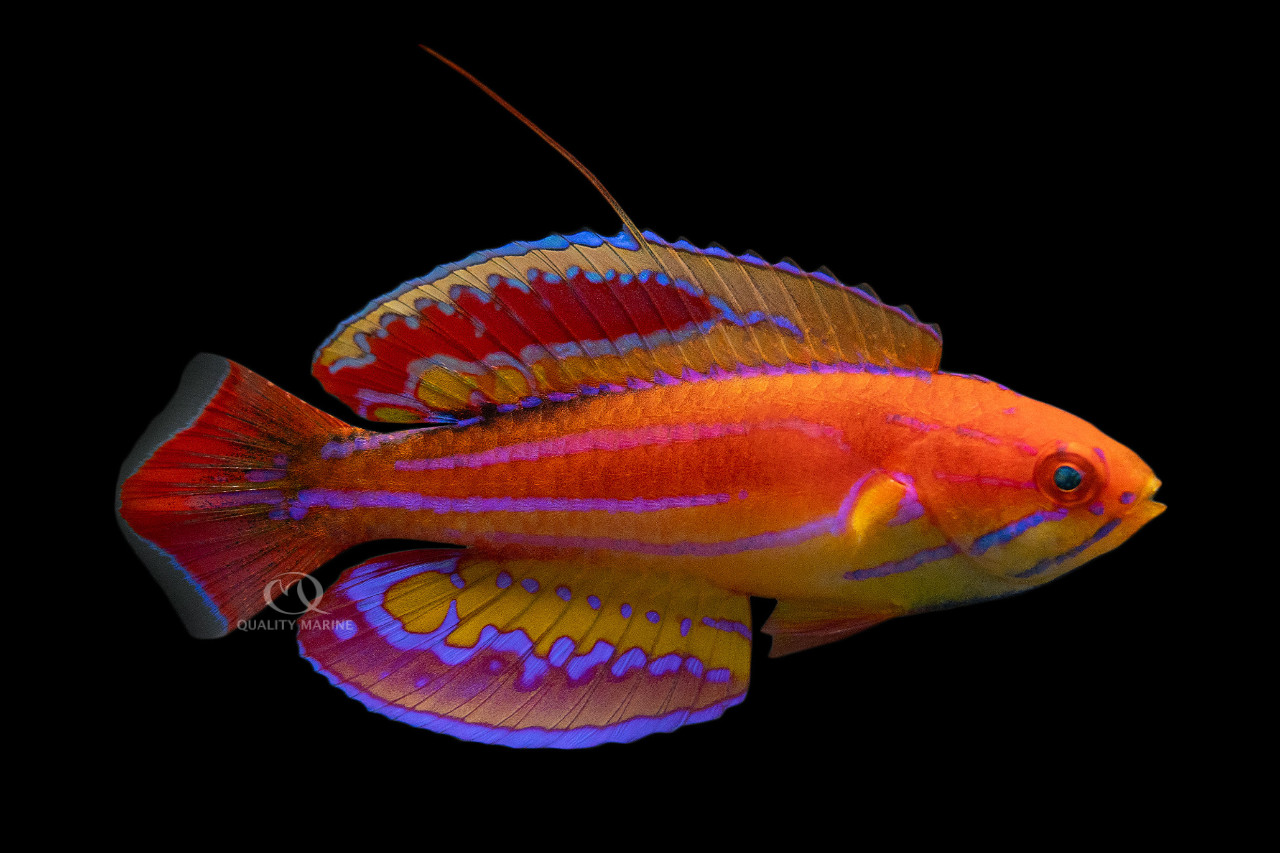
Paracheilinus attenuatus goes under a few different names depending on who you ask, here at Quality Marine, we use the most common of the common names: Diamond Tail Flasher Wrasse. You'll also hear it called the Royal Flasher or Lyretail Flasher (especially by OG – original geek - hobbyists who've been keeping this genus for years.) Whatever you call it, this is one of the most striking small wrasses to come out of East Africa, and it remains a bit of an underappreciated gem simply because collection numbers out of Kenya and the eastern Indian Ocean have always been modest compared to the more heavily exported Indo-Pacific flasher species (for a wide variety of political, logistical and safety reasons.) That relative scarcity is a shame in that this fish deserves a much bigger following than it has. On the other hand, it keeps this aquarium gem as rare as any jewel should be.
As is the case with all the fish in the Paracheilinus genus, the color difference between males and females of this species is dramatic enough that new hobbyists might assume they're looking at two entirely different fish. Mature males show off a gorgeous apple-red body with a yellow underside, cut through with horizontal blue or pink striping, and finished off with flaring dorsal and caudal fins that give the species its diamond-tail nickname. What's especially nice about this particular flasher is that the males hold onto that vivid coloration even outside of full nuptial display, unlike some Flasher species that only show their most amazing colors during those brief flashing bursts. Females, by contrast, are considerably more subdued, typically a soft orange dreamsicle color with almost no barring and only the faintest vestige of the diamond tail. Like every other member of this genus, Diamond Tail Flashers are protogynous hermaphrodites, meaning every fish starts life as a female, and the most socially dominant individual in a group will eventually transition into the single male.
That biology is exactly what makes keeping this species in a harem such a rewarding project, and honestly, we have long thought that a harem of Flasher Wrasses is one of the most underrated alternatives to keeping Anthias in groups. Anthias are gorgeous, no argument there, but depending on your choice of fish, they can be demanding. Flasher wrasses on the other hand are actually quite easy, while still delivering that same shimmering, active, harem-based display with the benefit of having one extra, straight fire stunner of a fish. A group consisting of one male Diamond Tail Flasher with three to five females is hardy, adaptable to a normal feeding schedule, genuinely peaceful, and just as visually captivating as any Anthias harem and perhaps more, minus most of the headaches. If you've been wanting that harem dynamic in your reef but aren't all in on Anthias, this is one path for you instead.
For tank size, we'd recommend at least a 50-gallon aquarium for a single male with a few females, and stepping up to 75 gallons or more if you want to keep a fuller harem of five to seven females. We suggest a minimum of four, though they could be kept singly. Diamond Tail Flashers are good candidates both for long and tall tanks. Aquascaping should strike a balance between rock work and open space. This species needs a clear stretch of swimming space above the rock to really show off, and an overly cluttered scape will just push the fish into constant hiding rather than confident cruising. That said, you want plenty of live rock arranged with swim-throughs, cracks, crevices, and small caves, since flasher wrasses dive for cover the instant they sense any threat, and the more places they have to hide, the bolder they will be. At night, they bury themselves into the rockwork to sleep, so there needs to be enough hotel rooms for the Diamond Tails too.
As for reef compatibility, Diamond Tail Flashers are about as good as it gets. They're completely reef safe, they won't so much as look at a coral, and their small mouths mean they pose no threat to sessile invertebrates of any kind. Ornamental shrimp, snails, hermit crabs, and the vast majority of desirable reef invertebrates all coexist without issue, and you can build out a genuinely diverse reef community around this species without a second thought. The only real caution is around other flasher and fairy wrasses, since males of similar species might spar over territory and the appearance of dominance, so if you're running multiple Paracheilinus or Cirrhilabrus species together (which can be done), make sure the tank has enough room and enough visual breaks in the rockwork for everyone to establish their own patch. Also, these fish can and will jump so lid that tank, really not joking, do it.
When you pick other fish to keep the Diamond Tail Flashers with, stick to the peaceful end of the spectrum. Small Gobies, other peaceful Wrasses, Clownfish, Cardinals, and other calm reef community fish all make excellent companions. Avoid anything aggressive or territorial enough to bully a naturally shy fish like this one into hiding. A Wrasse that never comes out to display is missing the point of keeping the species in the first place.
Feeding is refreshingly simple assuming nothing is scaring them into hiding. This species does best with at least a few small meals a day of meaty foods, and we build that routine around Gamma's frozen line, particularly Mysis Shrimp, Copepods, Rotifers and enriched brine shrimp, both of which are sized well and readily accepted. Gamma's Cyclop-eeze is another great addition for variety and for really bringing out color intensity in the male. For a reliable daily base to supplement those frozen feedings, Nutramar's Marine Complete Pellets and Crumbles are the way to go to maintain both health and that vivid coloration over the long term.
Given the chance to build a harem display around one truly standout species, the Diamond Tail Flasher Wrasse deserves all the consideration. It's hardy, endlessly interesting to watch, completely safe for even the most delicate reef, and it delivers rarity, ease of care, more color and movement than all but the most difficult and rare Anthias, without nearly as much of the fuss. This isn't going to be a cheap undertaking, but it is going to be an epic one. Ask your LFS to get you a male and four or more female Paracheilinus attenuatus from Quality Marine, give them the open swimming room and rockwork they're asking for, and enjoy one of the most incredibly dynamic displays the wrasse world has to offer.