No Cap, Black Caps
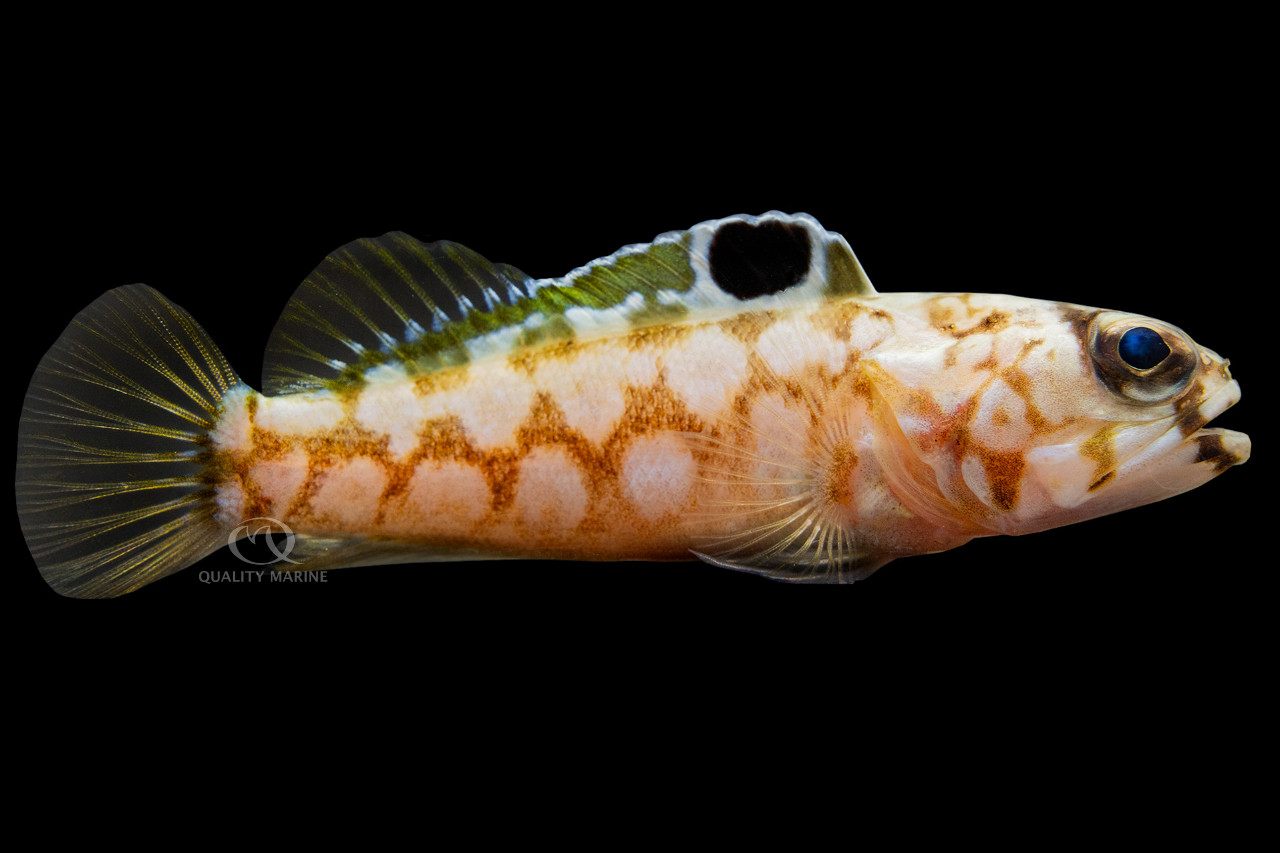
Every so often a fish comes along that manages to be simultaneously a fantastic display fish, a genuinely interesting behavioral study, and a great choice for aquarists who don't have the space / funds / time for a 200 (or more) gallon tank. Opistognathus randalli is exactly that fish. You'll see it sold under a handful of names, most commonly Black Cap Jawfish, Yellowbarred Jawfish, Tiger Jawfish, or Gold-specs Jawfish. The species name is a nod to the legendary ichthyologist Dr. John "Jack" Randall, a man whose name shows up on an enormous number of species tags of small marine fish (especially ones in this hobby,) including a certain Fairy Wrasse we've written about before. It's good company to be in.
In the wild, Blackcaps are found through Indonesia, the Philippines and eastern Borneo, living on sand and rubble flats near reef structure, usually in loose aggregations where every individual has dug and defended its own burrow. That burrowing instinct is the root of the personality of this fish, and it's the single most important thing to plan your aquarium around. Give them what they want here, and you'll have one of the most engaging, always-visible fish in your entire display; get it wrong and you'll have a fish that never really settles in.
One more cool thing before we get into tank setup: if you're lucky enough to keep a pair of Opistognathus randalli long term, you may get to witness one of the most amazing behaviors in the whole of aquarium keeping. Males are mouthbrooders, carrying a clutch of eggs in their jaw for roughly a week until they hatch, periodically shuffling and airing the clutch to keep it oxygenated. It's not something you should count on seeing in a home aquarium, but stable water quality, low stress, and a well-fed pair all improve your odds, and it's a genuinely special thing to catch if it happens.
Size-wise, Blackcap Jaws are little fish; topping out around four and a half inches, with most specimens settling in a bit under that. We suggest a tank of at least 30 gallons, and honestly, we like starting around 40 to 55 gallons if you can manage it, mostly because it gives you room to build a proper sand bed and some structure without the whole tank feeling like a jawfish beach condo.
Jawfish don't care how tall your tank is, but they very much care how much sand it can dig into; the substrate deserves forethought and planning. You want a minimum of three to four inches mixed grain size sand (our preference), and more is more here. Randall's Jawfish will dig burrows that go straight down before angling off, and they use pieces of rubble, shell fragments, and small rocks as structural bracing for the mouth of the tunnel, almost like rebar. If you're using a uniform sand, stick to medium grains or larger and then scatter some shell grit and small pieces of rubble rock into the sand bed before you add your fish, and they'll go straight to work incorporating that debris into the burrow. Place some live rock near where you'd like the burrow to be, since they like a den entrance tucked up against something solid. Important safety tip (thanks Egon): make sure all the rock you place is firmly on the bottom of the tank and stable. Jawfish excavations can cause rockslides. A secure, gap-free lid is non-negotiable. These fish can and will rocket straight up out of an open top tank the instant something startles them.
Temperament-wise, Opistognathus randalli is about as peaceful as marine fish get, and it's reef safe in the sense that it won't touch your corals. It will, however, happily eat anything small enough to fit in that surprisingly large mouth, so tiny ornamental shrimp like Sexy Shrimp or Peppermint-sized inverts, along with very small hermits could all be at some risk once the Jawfish is established. Larger, more robust inverts do fine. Snails, Cleaner Shrimp, Emerald Crabs, and Stars etc. will coexist without issue. Larger Nassarius Snails and other sifters like Sand Sifting Sea Stars are a genuinely good idea in this setup, since they'll help keep the sand bed itself healthy and aerated around all that burrowing activity. This is not a pistol shrimp type of burrowing Goby, so don't add one (we've got a few articles on those around here too.)
For fish tankmates, think peaceful and mid / upper water column. Things like Fairy and Flasher Wrasses, Firefish, Cardinalfish, the smaller and gentler of the Clowns, small, peaceful Wrasses and Gobies that don't compete for burrow space, and many Blennies make excellent companions. Avoid anything that's a notorious fin nipper and avoid anything large or boisterous enough to bully a fish that needs to feel safe enough to leave its hole to eat. You can keep a single Black Cap Jawfish quite happily, as well as a bonded pair, but that two unrelated males in the same tank is courting conflict, so if you want more than one, source them as an established pair whenever you can, or be prepared to give them serious distance and broken sight lines in a larger footprint display.
Feeding is genuinely easy once these Jawfish are settled; these are ambush planktivores in the wild, hovering at the burrow entrance and grabbing anything food shaped that drifts past. In house, we feed a rotating mix of Gamma frozen foods, leaning on Mysis, Chopped Mussel / Prawn, and the Brine Plus line (Garlic, Spirulina and Omega 3) to keep the diet varied and nutritionally complete. Nutramar Complete Pellets are a perfect staple that takes a lot of the guesswork out of feeding, and your new fish will accept them in short order, just keep offering the pellets at the same time as the thawed offerings and they'll be on the pellets in no time. New arrivals can be hesitant about eating in the open initially, so if yours is shy, keep the lighting a little lower than usual at first, feed from a distance, and be patient. Once a jawfish learns that your presence at the tank means food is coming, that shyness disappears and you'll have a fish waiting at the mouth of its burrow every time you walk by.
Water chemistry requirements are unremarkable; if you're already running a healthy reef system, you have everything this fish needs. Keep parameters stable, keep the sand bed intact and undisturbed by aggressive digging tankmates, and give it time to establish its burrow before you judge how bold it's going to be. Few fish in this hobby offer this much personality, this much visible behavior, and this manageable of a footprint all at once. If you've been looking for a little-bit-different centerpiece fish for a reasonably sized aquarium tank that isn't a clownfish or a goby, ask your Local Fish Store to get you an Opistognathus randalli from Quality Marine today.