New seahorse species named after our director and co-founder, Prof. Amanda Vincent
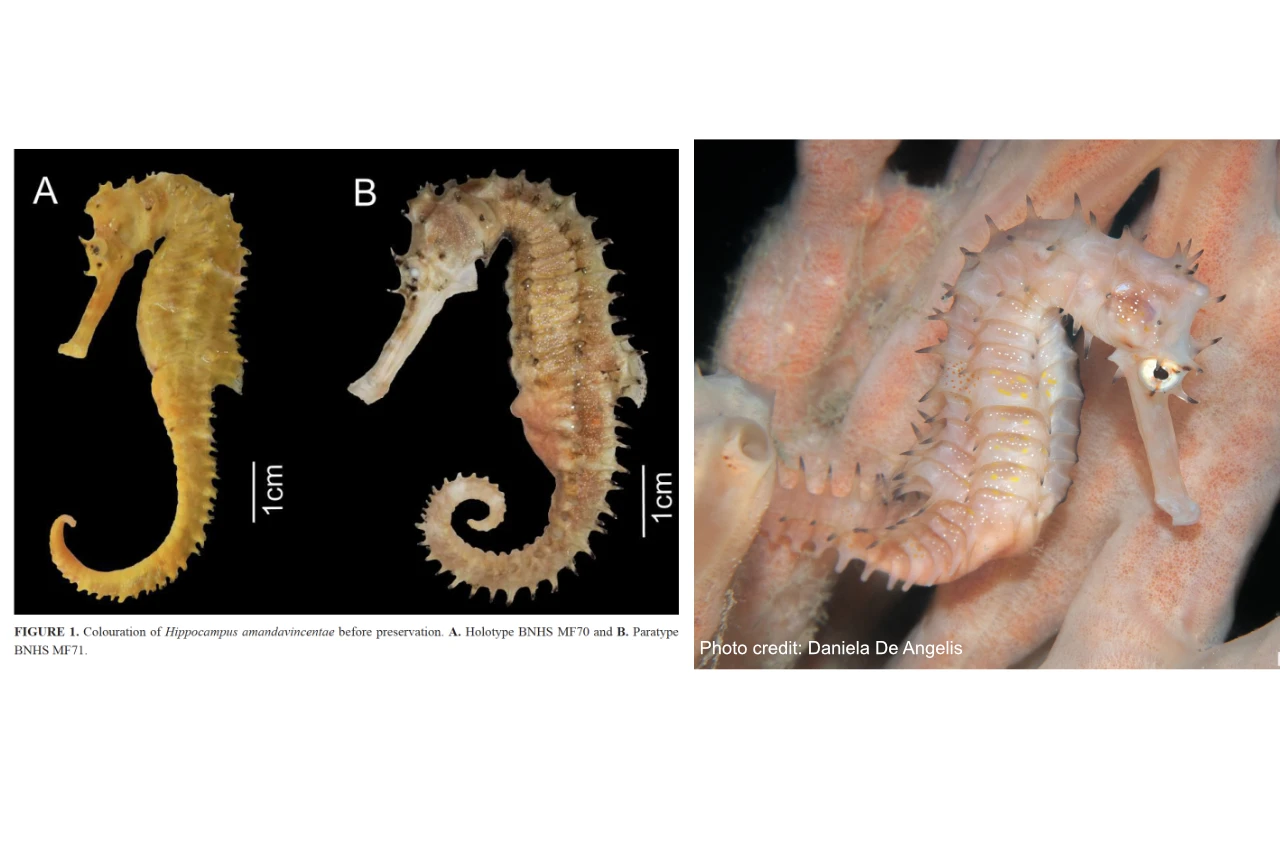
An international team of scientists has identified and named a new seahorse species from the Indian Ocean, Hippocampus amandavincentae, in honor of marine conservationist Prof. Amanda Vincent, co-founder and director of Project Seahorse. The species was discovered among fish bycatch at Tuticorin Harbour in southern India and is approximately 16 cm long, with a short snout, a distinctive five-spined crown, and numerous spines along its body and tail. Its range is believed to extend from Mozambique and the Red Sea to India.
The discovery also revealed that what scientists had long considered a single species, Hippocampus histrix, actually represents three distinct species: H. amandavincentae, H. histrix, and H. jayakari. Researchers reached this conclusion by examining physical characteristics, analyzing DNA, and studying historical museum specimens. Accurate identification is essential for understanding species distribution and population health and for developing effective conservation strategies.
The naming of H. amandavincentae recognizes Vincent’s decades of pioneering work in seahorse research and marine conservation, including her groundbreaking underwater studies and the creation of Project Seahorse. The discovery is especially significant because seahorses face threats from unsustainable fishing, habitat loss, exploitation, and the aquarium and traditional medicine trades. All seahorse species are regulated under CITES Appendix II, while India provides them with its highest level of protection. The researchers hope that recognizing this new species will strengthen efforts to protect its populations and the ecosystems they depend on. To learn more read Rabia Mushtaq’s article New seahorse species named after our director and co-founder, Prof. Amanda Vincent - Project Seahorse