Into The Abyss
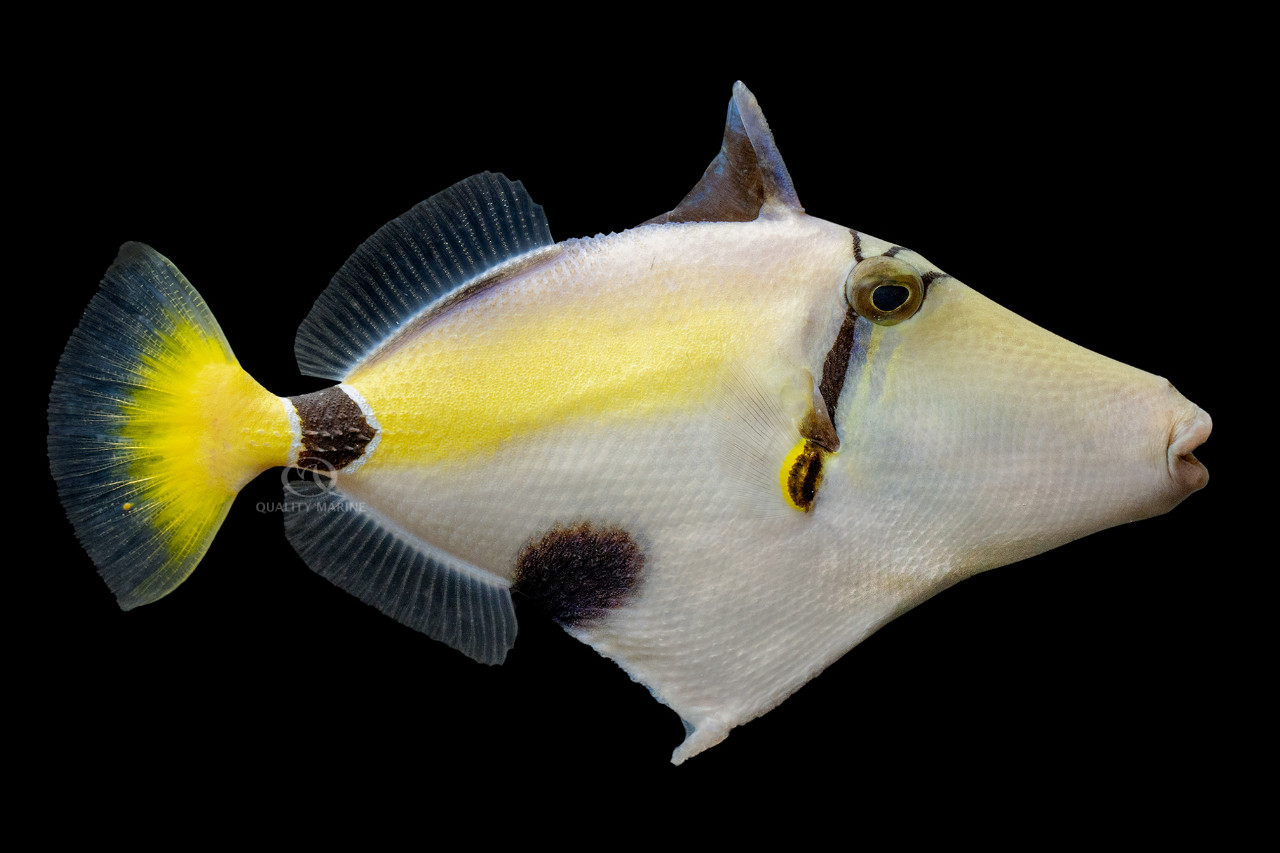
Every so often a fish shows up that sends a buzz through the whole facility here at Quality Marine. Rhinecanthus abyssus is one of those fish, and we know have, in stock right now, the first we've ever had here. We're not going to pretend we stayed cool about it. Triggerfish people will understand, and everyone else is about to learn a little something.
First, the name. This species has never really settled on a common name, which figures as if never really gets seen by anyone! You'll see it called the Deepwater Triggerfish a lot in articles and journals. It's a good name because it tells you most of what matters about the fish: it doesn't live where the rest of its genus does. In house, we call it the Abyssal Triggerfish which is probably the most widely used common name and also a nod to its species name. Some enthusiasts use Deepwater Picasso Triggerfish to place it among its shallower water look alikes.
The Deepwater part is the heart of the rarity. Rhinecanthus abyssus was described in 1989 from the Ryukyu Islands of Japan, based on a very small handful of specimens that came up on hook and line from around 150 meters (just shy of 500 feet). The rest of the genus lives in lagoons, reef flats, and shallow rubble, which is one reason why they're so commonly seen. This one stayed down in the mesophotic zone (the edge of light penetration), well beyond the reach of any normal collecting dive, and for decades it was a fish you read about rather than a fish you saw. The list of people who've seen one in an aquarium is a very, very short, and we can't think of a better way to describe the "holy grail" tier of triggerfish than that.
For a fish with this reputation, it's a small one, and that's one of the best things about it! The species tops out at around six and a half inches, which makes it one of the smallest triggers you'll ever work with. Don't let that fool you into thinking a tiny little tank will do. Rhinecanthus are active, territorial swimmers that patrol their space all day, so we recommend a minimum of 75 gallons, and honestly, we'd go much bigger if you can swing it (think 125 plus). Length / width matters more than height for this species. Strong, varied flow with good oxygenation is a smart idea for a fish from open, current-swept slopes, You don't need to light the tank like an SPS reef, though they will probably be fine in high intensity lighting if you acclimate them to this condition over a couple weeks. Cover the tank, while the genus is not notorious for jumping who wants to take a chance with a fish this rare?
Aquascaping is where you can really help this fish settle in. Like all Rhinecanthus, Abyssal Triggers like to wedge themselves into a crevice at night and lock in with their dorsal spine, so give them rockwork with caves, overhangs, and more than one way in and out. Build the structure so it's seriously stable, sitting directly on the glass or tank bottom. Triggers will test your rockwork, and a rockslide is not how you want to start (or end) a relationship with a one-of-one fish. These are good fish for bare bottom aquariums but would also be fine over sand or rubble. Leave open swimming lanes between the rock piles so the fish can patrol, and this isn't a good species for the old “solid wall from end to end” aquascape.
There is essentially no husbandry record for this species until now, so what follows is what has been working for us. We used its depth, its relatives, and our experience with other deep-water triggers and other Rhinecanthus triggers in general as a starting point. Standard marine parameters are the foundation: salinity at natural seawater levels (1.020-1.026), a stable pH in the 8.1 to 8.4 range, alkalinity in the normal reef range, and nitrate and phosphate kept low. Because this fish comes from deep water that is generally cooler and more stable than surface water, we suggest keeping your display on the cooler side of a normal tropical range, in the low to mid 70s °F, and keep it rock steady. Stability will do more for this fish than any specific number.
Choosing tankmates for Rhinecanthus takes some forethought. While your Abyssal Trigger is unlikely to directly bother your corals, it is absolutely going to eat clams, snails, crabs, shrimp, urchins, tube worms, even starfish, and most other motile invertebrates. This makes a traditional reef cleanup crew challenging. They're also big eaters and thus big waste producers, so water quality is a consideration for keeping corals. Choose robust corals if you're going to go down this path; we suggest you think about things like Pumping Xenia, Colt Corals, Star Polyps etc. For fish companions, think strong and similarly sized: Tangs, Thalassoma (and other larger) Wrasses, and Angels are all good choices. Even things like certain Damsels and large Clowns could be cool additions in the right system. Skip anything slow, long-finned, and / or timid, and be careful with other Rhinecanthus unless the tank is very large. Maybe think about it like this; if you're keeping a one-of-one specimen of a species, a display where it's the star is a perfectly good plan.
Feeding is the easy part, and it's the same philosophy we apply to any trigger. These are CARNIVORES, so we offer a rotating mix of Gamma frozen Mysis, Blood Worms, Chopped Prawn, Chopped Mussel, and even some Cockle in Shell to help keep those choppers in good shape. Nutramar Complete Pellets are our go-to staple to build in alongside the thawed foods, and a variety-first approach will keep the fish healthy. Here we feed Rhinecanthus twice a day and once a day would be fine for larger specimens.
A fish like this doesn't come around often. Actually, a species like this doesn't show up pretty much ever, and we're not sure when we'll see another. If you've been waiting for one, you already know this is likely your one and only shot at having one. If you got introduced the this beauty of the abyss today, then maybe it's your lucky day. If you have the right tank and the budget, and the desire to have what might be the rarest Rhinecanthus in the hobby, talk to your Local Fish Store about Rhinecanthus abyssus from Quality Marine and do it quick.