They Call Him Mellow Yellow
Sir Peter Markham Scott was a unique individual. The son of a famous Antarctic explorer Robert Falcon Scott, Sir Peter was an accomplished conservationist, waterfowl hunter and breeder, naval officer, broadcaster and even a painter of some renown before his passing in 1989. This happened to be the same year that Scott's Fairy Wrasse was cataloged for science by John (Jack) Randall and Richard Pyle. Now you know why / how Cirrhilabrus scottorum got its name. It known as Scott's Fairy Wrasse everywhere in the world but China, and there its name is google translated as “Dark-striped Wrasse.”
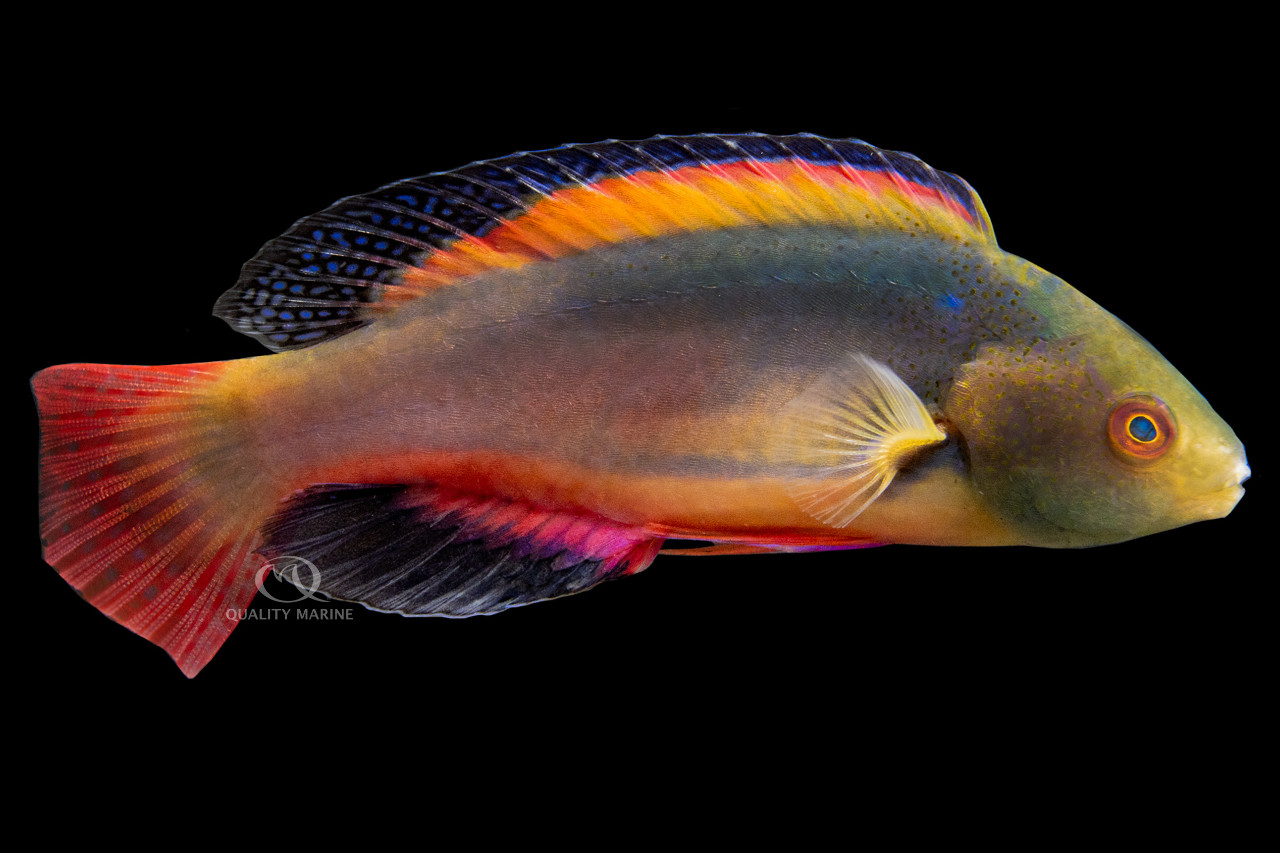
One of the most interesting things about Cirrhilabrus scottorum is that they come from a large range that goes from Indonesia to the central Pacific. Individuals show an interesting amount of diversity in their coloration and patterns even from a single collection site, when looked at from various collection sites from all over their natural range, the difference in colors and patterns can be fairly intense. Every single one of them (at least the males) feature incredible colors that softly blend into each other. Nearly all the different variations have a prominent red blotch on their side to one degree or another. Most of them are some shade of beautiful soft green over most of their bodies fading softly to a yellowish belly (with the famous red blotch) and often a red tail. Among many of us, the Yellow variant is a favorite and is likely the most sought after outside the building too. The body of the Yellows is a deep ocean blue and ruby red, with absolutely brilliant yellow belly and dorsal fin. All Scott's Fairy's are beautiful, but the Yellow variant is a jaw dropper.
It comes from the islands of the Central Pacific and is most often found on the unprotected side of shallow coral reefs. There they live in groups that are mostly juveniles and females, with a few sporadic males spread throughout. You don't need to mimic this in your own display, but you should. Like all Cirrhilabrus, these fish like to be kept in harems, and they look amazing this way. They'll be much more active and bolder more quickly after their introduction. A group of four or five females and one male is a great group, and more females could be added. Keeping Scott's this way will also help the male retain his showy colors as he will need to impress all those ladies. You can keep more than one male if you have a big enough aquarium, enough hiding places and enough females for them to court.
That group of six could be kept in a 55-gallon aquarium, as long as it was fairly sparsely populated other than the wrasses. They can get up to five inches long or so, but the females will more commonly be around three to three and a half while the males will usually be about four inches long at adulthood. The display should have a ton of current, at least 20 times the total tank volume per hour. There should be copious amounts of rock, but also plenty of room for activities. They don't need a sandbed as they'll find hidey holes in the rock to sleep in, bare bottom displays are totally acceptable. Any display with a Cirrhilabrus wrasse should always be covered; they dart when startled and can do so right out of the tank. As a generally shallow water fish, Scott's Fairy Wrasses aren't bothered by bright lighting.
They're also 99.99% not going to eat corals, making them pretty much ideal for reef tanks (love flow, love light, don't love eating stuff you love.) The largest specimens might try to eat the tiniest of your shrimp, like Perclimines genus stuff, but other than that, you shouldn't have a problem. They're also going to be super peaceful with other fish. They're not going to bother pretty much anything with the possible exception of males not liking other male fairy wrasses, and this is a case-by-case basis. They can be shy when initially introduced but keeping them in a group will help that go away faster. They'll be plenty bold in time and once acclimated are one of the boldest Fairy Wrasses you can keep. The only fish you might want to be cautious about are things that could eat the Wrasses like Groupers, Eels, etc and things that are notorious fin nippers like Puffers etc.
In the wild Cirrhilabrus scottorum spends its day hovering in the flow, eating any meaty bit that floats past, which makes them pretty easy to feed as long as they aren't hiding. They'll generally take any thawed food right away, and in house we give them a mix from Gamma Foods that changes every day, but is usually composed of stuff like Chopped Mussel, Chopped Prawn, Mysis, Bloodworms, Copepods, Brine and all the Brine Plus products (Garlic, Spirulina, Omega 3) among others. We also feed them the Nutramar Saltwater Complete Pellets and Crumbles. We really like the Crumbles for their high nutritional value and their varied bite size, especially when feeding aquariums that have a lot of different sized mouths to feed.
Scott's Fairy Wrasses aren't super picky about water chemistry and if you're successfully keeping a reef aquarium, you won't need to change a thing. These fish are that perfect intersection between gorgeous to look at, easy to keep and small enough to keep that just doesn't come as often as everyone would like! To make matters better, they're super active and fun to watch, especially when kept as a harem. Sounds like your idea of amazing? Our's too. Head to your Local Fish Store and ask them to get you a group of Cirrhilabrus scottorum cf Yellow from Quality Marine today!