The God of the Sea
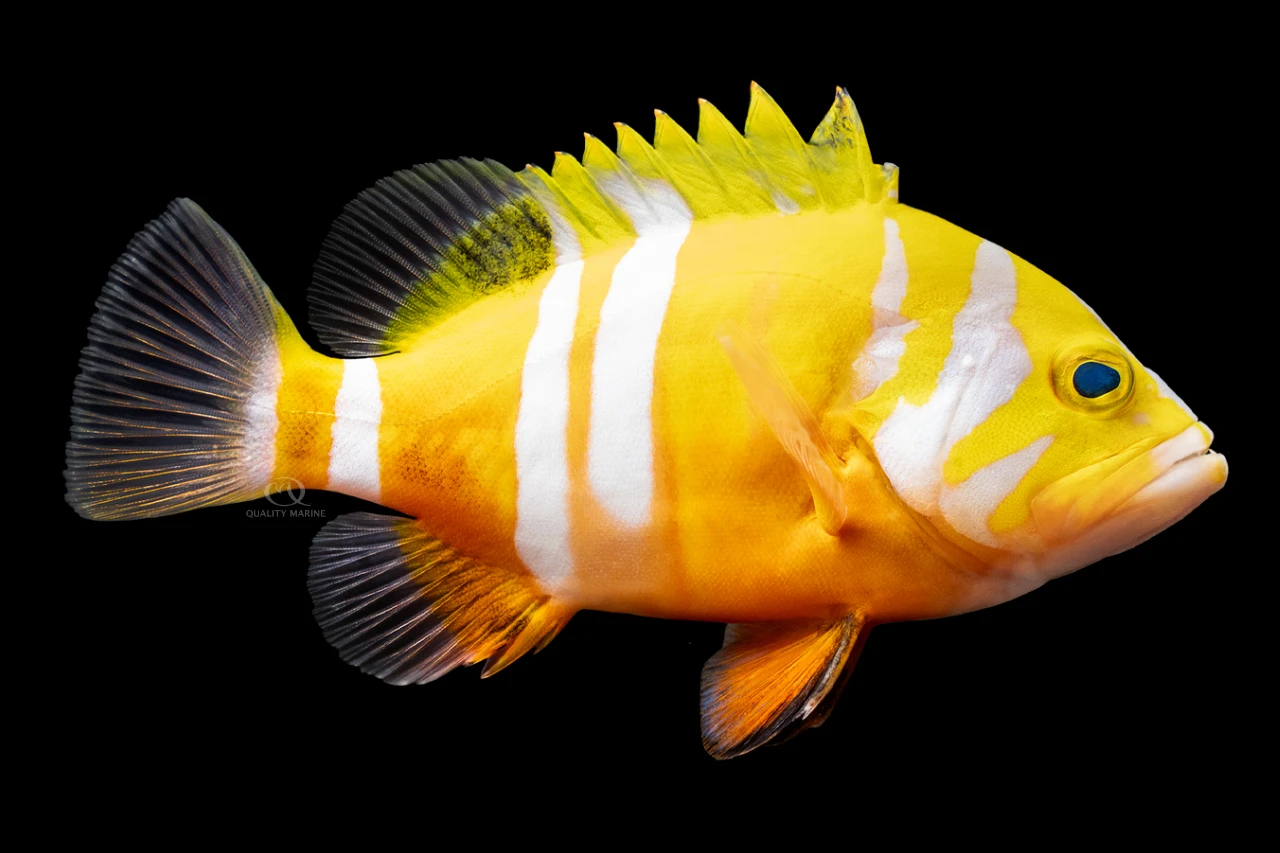
What is a “Holy Grail” fish? It's the one you've dreamt of keeping from the first time you saw it but couldn't have for one reason or another. Either your aquarium wasn't big enough, or stable enough, or you had too many other things that weren't good matches as tankmates for that fish. Maybe you just straight up couldn't afford it. Regardless of the reason, you couldn't then, and it's likely you haven't seen one available since. It lives rent-free in your head. Perhaps you fell hard for Conspicuous Angels, Claire's Fairy Wrasses, or a Dr. Seuss Fish? Maybe you've been lucky enough to have seen a Candycane Femininus Wrasse or a Flathead Perch (ermagerd) and will never get them out of your head. The point is that occasionally, along comes an aquarium fish that is just mind boggling and today is one of those days, because we have a Neptune Grouper.
Now we could end this here for many of you, who've already fallen for one but the Neptune Grouper is so rarely seen, that it deserves an introduction to the rest of you. This is a fish with many aliases, which is odd for something so rare that it is only seen in North America a couple times a decade (at least alive and not being served.) Scientifically, it is known to the world as Cephalopholis igarashiensis. If you're lucky enough to see in on a sushi menu, you're probably in Japan, and it's going to be called Shimahata (it is delicious). Depending on where else you are in the world, you might see it labeled as Garish Hind and Garish Rockcod, as well as Goldbar Grouper or Japanese Cod as well as a few more non-English names across the globe.
If you travel throughout the Pacific Tropics, it’s within the realm of possibility that you might see it in a fresh fish market anywhere across its natural range, from southern Japan to Northern Fiji, from Malaysia in the west to Hawaii in the east. Again, these fish aren't often seen, even there, because they're pretty much never caught less than 250 feet deep, and the deepest one recorded was over 850 feet down!
Groupers generally get massive, but this is a big family of fish (Serranidae) and within it there is a really large range of sizes. The biggest ones almost always have stunning colors as juveniles, but the colors often fade over time. The Neptune Grouper is a lovely exception to this rule in that they stay gorgeous throughout their lives and while they do get big for an aquarium fish, it isn't so big they can't be kept in an aquarium that is achievable by most of us. Curious? How big exactly are we talking here? The biggest one on record is a two and half pounder caught in American Samoa (by an angler named Brian Peck). They can get up to 18 inches or so, but this is a rare size indeed. Adult fish are more often in the 12-to-16-inch range; still a large aquarium critter. That being said, Groupers are very sedentary. They'd sit in one spot all year as long as enough food came swimming / strolling past for them to ambush.
All this relates to an aquarium that is about 180 gallons, and we prefer the six foot long, two-foot-wide version. It's enough footprint for them to turn around, and it offers enough space to create multiple hiding spots for them. Both the four foot square, two-foot-deep version and the eight foot long, two-foot-wide versions of the 240-gallon tank are also a great choices. Of course, as with any large fish, more space isn't going to hurt. Rockwork in this tank should offer a couple of large caves for your grouper to hide in and obviously, having those visible from the front of the tank is nice so you can see your gorgeous fish more often. The rest of the aquarium can be aquascaped however you'd like. Are plastic castles your thing? Go for it. It's not for us; we'd suggest a bit of open swimming space and some artistic rock work with arches or overhangs. Sand, if utilized, can be whatever you'd like.
Neptunes live in rocky areas in the wild and so they don't need sand in a display, and a bare bottom tank will be easier to keep clean. These are big fish, with big appetites (which we'll come back to) and so they produce quite a bit of waste and filtering this waste is easier in tanks that don't have any substrate to catch it. The bottom of the aquarium will cover with coralline algae in time, which looks great. On this topic, groupers are pretty hardy when it comes to nitrogenous waste, but we still recommend keeping your nitrates under 5ppm to help prevent other problems. This will take strong filtration (overturn the volume of the tank at least 20 times an hour) as well as regular and reasonably sized water changes. The rest of the water chemistry is pretty standard stuff. You'll want to keep your specific gravity (SG) between 1.020 and 1.026, your pH between 8.0 and 8.4 and your temperature could be anywhere in a wide range. The water they were caught in is likely 55-65 degrees Fahrenheit, but they are very adaptable and will do just fine as long as the temp is under 78 degrees; all of these parameters (especially the temperature) should be stable at whatever you choose. The depths that Neptune Groupers come from offer very stable conditions and you should mimic this as closely as possible.
Your Neptune Grouper is supremely unlikely to actively bother your corals. They have no interest in them as food. Conversely, the grouper comes from a very dark environment, and reef style lighting would be quite stressful, so you'd need to acclimate this fish slowly to that type of environment. As we touched on, they also produce a lot of waste so choosing corals that aren't likely to brown out if nutrient levels are inconsistent, is a good idea. Pumping Xenia, Toadstool Leathers, a huge variety of Polyps, Mushrooms, Zoas and others could all work really well in a Neptune Grouper display; stony corals are feasible but would require even more intense dedication to water quality.
Feeding Cephalopholis igarashiensis is very easy, they like to eat. In fact, it might be a bit too easy in that they'll eat just about anything that they can fit in their mouths. Like most groupers, they're quite capable of eating fish and inverts up to a third of their own length. This means a nine-inch Neptune grouper will loooove the opportunity to eat fish up to three inches long in your tank. This includes your Fairy Wrasses, Small Anthias, Damsels, Peppermint Shrimp, Chromies etc. You get the idea. We suggest keeping these groupers with large fish that are relatively peaceful. Things like Xanthichthys & Melichthys Triggers, Thalassoma Wrasses, Tangs, many Angels, Big Scorpionfish and Lionfish all make for cool display partners. If you want a lot of activity in the vein of dither type fish, either be prepared to lose them (think saltwater mollies that you're raising and this is part of the diet of the Grouper), or choose large fast ones like Fusilers or some of the larger Anthias.
On the topic of feeding them, they'd love the mollies, although you'd need to be sure you had a clean source for them and gut load them with a high-quality food like Nutramar Complete before adding them to the aquarium to ensure they supplied adequate nutrition to your grouper. An easier way is to use Gamma Foods like Whole Fish, Whole Mussel and Whole Cockle. Most Neptunes will take these foods without much fuss, though you might need to use a feeding stick when your fish is first introduced to give the food some activity. Neptune Groupers can also be trained to take pellets, like the Nutramar Marine Complete. Smaller specimens can be fed the 1.75mm pellets and larger fish can actually be fed the 12mm Shots as though they were normal sinking pellets. Nutramar Pellets and Shots offer a protein density and nutrient spectrum that is impossible to replicate naturally in such a small package. If your fish is less than five inches long, you can feed them every day, once they get bigger than that, you should slow down to feeding every other, or every third day, but feed larger meals.
Some of you are lucky enough to be able to say, “We've already got one, oh yes, it's very nice!” when talking about your own Holy Grail Fish, but most of us are still on our own quest. If you've got the tank and the budget, your opportunity to own one of the most uncommon and beautiful fish in the marine aquarium hobby has come.