Heavenly Nudibranchs
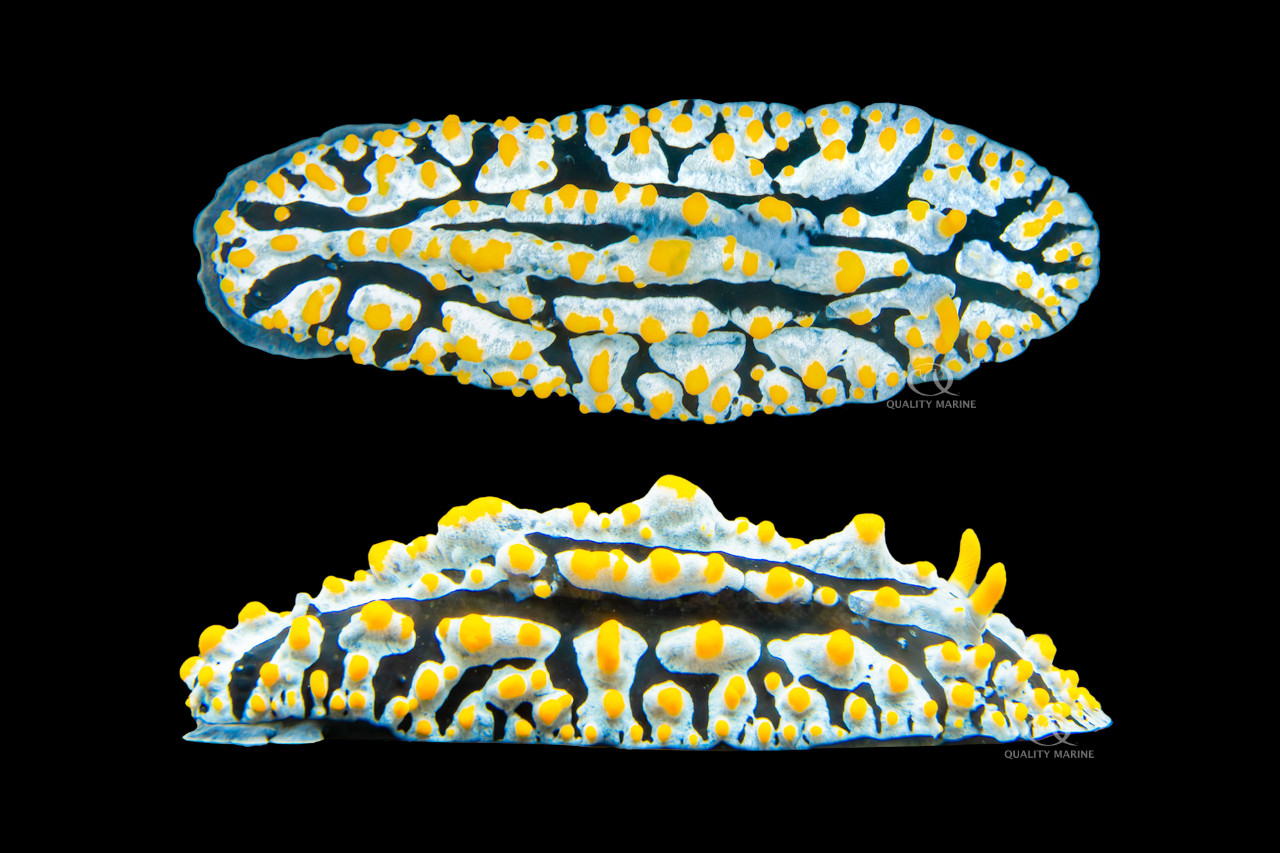
Phyllidia coelestis is better known by the accurate and descriptive name Yellow Tip Blue Nudibranch. It also gets called the Heavenly Nudibranch, because “coelestis” is Latin and translates roughly as “of the sky” a reference to P. coelestis's blue base coloration. Less commonly you might see it as the Celestial Phyllidia, or the Sky Blue Phyllidia. There are tons of different nudibranchs in the oceans of the world, and Phyllidia coelestis bears a resemblance to more than two, but in your LFS you're really only likely to see them and Phyllidia varicosa. These two look nearly identical, but the Phyllidia coelestis has a blue/black line running down the middle of their back and this line gets interrupted by the yellow tubercles.
These are extremely common Nudibranchs in the wild, but much less common in aquariums. They're usually collected in shallow water (from tidal zones down to about 100 feet deep), all across the tropical Indian Ocean and Indo-Pacific. They are always in areas of clear, clean water, and never in areas of high sediment or turbidity. As this relates to your aquarium, you're going to want an environment that is stable in all parameters and low in nutrients. Specific gravity needs to be rock solid at 1.025 or 1.026, with a pH that is similarly stable between 8.0 and 8.4. There should never be any detectable ammonia or nitrite, and nitrates should be kept under 1ppm. All nudibranchs are hyper-sensitive to copper so be very careful reading labels of anything you put in this display. As they often come from shallow water, they're tolerant of a wide range of temperatures as long as those temperatures are relatively stable.
That all sounds pretty doable right? So why are nudibranchs, and Phyllidia coelestis in particular always listed as “expert only” or “difficult” aquarium items? There are really two aspects to this, one is risk, which is related to the second part, and that is diet. Nudibranchs generally have a one-track mind when it comes to what they eat. They're like a four-year-old that only wants chicken nuggets except when the nudi, its whole digestive system has evolved around chicken nuggets, or whatever that specific nudibranch eats. Some Nudis will eat hair algae, some will eat aptasia, some will eat coral polyps. Yellow Tip Blues Eat sponges, and only sponges. There is some variation in the sponges they will eat, which is probably a feature of the widespan of ocean and range of depths they get collected from. This means your Nudibranch has to always have some sponge to eat, or they starve. This isn't one of those situations where you can segue them onto another food and they'll be fine. You're going to either farm sponges (grow them in another tank to be used as food in your display) or continue to buy them. Luckily, there are a few sponges that are both available commercially and are common food items for Phyllidia coelestis. You'll need to find Axinella and Acanthella genus sponges, and Quality Marine offers our partner stores a few sponges that fit this description. https://www.qualitymarine.com/quality-marine/coral/sponges/ It's possible that your specific Yellow Tip Blue Nudibranch will eat other sponges and this will be a matter of exploration for you.
The other part of why everyone doesn't keep Nudibranchs is the risk. Yellow Tip Blue Nudibranchs have a built-in toxicity that results from bioaccumulation as they eat their favorite sponges. They can secrete this if picked on / stressed, which can then stress or kill other fish and inverts in your system. This release of toxins can be catastrophic if your Nudibranch dies and doesn't get immediately removed from the system.
This has multiple implications on the husbandry of Phyllidia coelestis. One is that they need almost no space in an aquarium but will do best in a very large one. Larger tanks allow for more natural sponge growth, much better stability and more dilution for nutrients or toxins if released. This tiny little critter is best off in a tank that is at least 40 gallons and would be much better off in something like 90 plus. The more rock you have the better, and this is one of those instances where real live rock brings a real palpable benefit. The wild sponge growth that comes on natural live rock is impossible to achieve with faux rock unless it has been cultured in the ocean.
Phyllidia coelestis is stunningly gorgeous but is also only ever going to get two to two and a half inches long. You could keep one by itself in a fairly petite aquarium, but most of you are going to want a little more activity in your tank. It is imperative that you keep them with very peaceful fish that are absolutely not going to pick on the Nudibranch. In smaller tanks, things like Seahorses and Dragonettes are good possibilities. In larger tanks you could think about fish like Cardinals, Firefish, and Fairy Wrasses. Avoid anything that might even think about taking an exploratory nip or a territorial bite of your Nudibranch.
Yellow Tip Blue Nudibranchs aren't for everyone, in fact, they're really only appropriate for the most dedicated of you. They are an incredibly beautiful and rare item to put into your home aquarium and can really anchor a display that is set up for them specifically. If you're willing to deal with their diet requirements and are the kind of aquarist that loves to have something in their tank that no one else does, you might be the right kind of keeper for Phyllidia coelestis. Ask your LFS about getting you one from Quality Marine and get some sponges at the same time!