Level Up Your Cichlid Tank
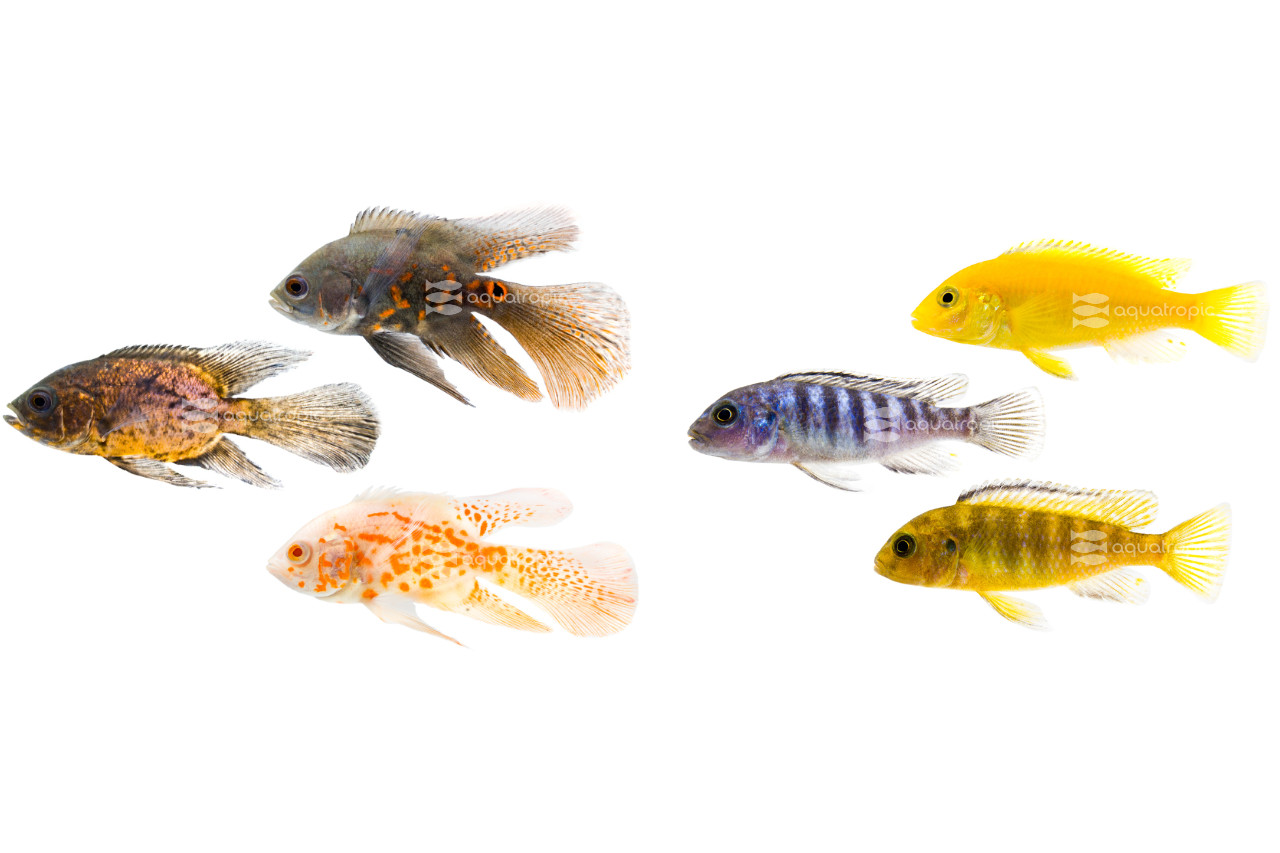
Cichlids are, without question, one of the biggest (and most rewarding) families in the freshwater hobby, and also one of the most misused. Too many people try to build a "cichlid tank" the way they'd build a community tank, tossing together fish from three (or more) different continents and hoping for the best. Sometimes this works out, but just as often, this lack of planning sells the fish short. The real magic of cichlids happens when you commit to a biotope, a tank built around fish that actually evolved together, in the same rivers or the same rift lake, under the same pressures. You don't need a 500-gallon monster to do this properly either. With good stocking choices and a bit of restraint, a genuinely spectacular biotope cichlid tank can fit much more comfortably in most of our budgets.
Let's start in South America, because this is where cichlids as a family really show their range. A South American biotope built around Amazonian and Orinoco basin species tends to favor a blackwater or slow-moving river look, with soft acidic water, driftwood, and a substrate on the darker side. The centerpiece fish for a tank like this is almost always the Oscar, and for good reason. Who doesn't love a Tiger Oscar, but for some extra flash, Albino Longfin Oscar and Albino Tiger Oscar are both striking, personable, genuinely intelligent fish that will recognize you and beg at the glass like a dog waiting for dinner. Oscars get large, so if we limit this discussion to aquariums less than 240 gallons, you're realistically keeping (as adult fish) a mated pair rather than a group, but that's part of the appeal. A big Oscar (or two) in a well-aquascaped 180-to-250-gallon tank, with some open swimming room and a few sturdy pieces of driftwood, is an absolute showpiece.
Around that Oscar, you build texture with the dwarf and mid-size South Americans. The Bandit, Acarichthys geayi, is an underrated choice here, an active substrate sifter with a striking black eye stripe that adds movement without adding aggression. For the lower and middle water column, the Acara group does a lot of heavy lifting. Acara Blue brings a shimmering, almost pearlescent color that catches the light beautifully over a dark substrate, while the Acara Dwarf Thayeri and Acara Redbreast stay small enough to work in a shared tank without getting bullied out of it, and both display genuine parental care if they pair off, which is a treat to watch. None of these fish need enormous territories the way the biggest South American cichlids do, which is exactly why this combination works so well in a tank that tops out around 200 gallons. Keep the Oscar as your single dominant personality, layer in Bandits and Acaras as your supporting cast, leave plenty of driftwood and broken sightlines to diffuse tension, and you've got a South American biotope that looks and behaves like a real slice of the Amazon.
Central America asks for a different mindset entirely. These are rockier, harder water systems, and the fish that evolved there tend to be tougher, more territorial, and considerably more bull-dozery in how they use a tank. This is where you lean into rockwork, caves, and a harder substrate, since these fish will rearrange whatever you give them anyway. The Amarillo, Amphilophus amarillo, is a fantastic centerpiece for this kind of build, a Nicaraguan cichlid with a big personality, a gorgeous golden-yellow coloration and the classic thick body type that Central American cichlid fans love. The Angostura Cichlid, Vieja breidohri, brings a similar presence with a different look, more patterned and a bit more reserved in temperament, but still absolutely capable of holding its own territory.
The Altifrons Horsehead Cichlid, Cribroheros altifrons, earns its name from the pronounced nuchal hump the males develop, and it's a genuinely impressive fish once mature, with a face and profile that looks almost prehistoric. Pair that visual weight with the Aureus Red Flash, Thorichthys aureus, a smaller and more peaceful firemouth relative that adds color and activity in the mid to lower water column without challenging your bigger cichlids for territory. In a 180-to-240-gallon tank, a single dominant pair of Amarillo or Angostura, combined with an Altifrons Horsehead and a small group of Aureus Red Flash, gives you real Central American drama, rockwork battles, courtship displays, territorial standoffs, without pushing the bioload or aggression past what a tank this size can handle. The key with Central American Cichlids is always giving them enough broken lines of sight and defensible territory that the aggression gets distributed instead of concentrated on one unlucky tankmate.
Then there's the rift lake tanks; ahhh Africa. If you've never kept one, you owe it to yourself to do this. African Cichlid Tanks probably create more aquarium enthusiasts than any other type of display (save goldfish perhaps). There's more than a few aquarists here for whom African Cichlids was the gateway tank to a life full of aquariums. A Malawi or Tanganyikan tank is a completely different animal from the two biotopes above, hard alkaline water, open rockwork, and a stocking density that would be irresponsible in almost any other context but works precisely because these fish evolved in packed, competitive rocky shorelines.
For a Malawi-style tank, the Mbuna and Peacock groups give you an enormous amount of color to work with. The Auratus Malawi Cichlid and Auratus Blue Cichlid bring that classic yellow and blue-black striping that most people picture when they think "African cichlid," while the Acei White Tail and the various Afra species, including Afra Edwardi Cobue, Afra Jalo Reef, and Afra White Top Hara, add electric blues and barring patterns that pack a huge amount of visual variety into a relatively small footprint. For pure color saturation, nothing beats the Peacocks. The Apache Peacock and the albino forms, Albino Scarlet Peacock and Albino Strawberry Peacock, bring softer, almost pastel tones that contrast beautifully against the punchier Mbuna coloring, and the Annectens Blue adds a deep, almost electric blue hap presence to round things out. The Albino Zebra Malawi and Albino Red Top Ice Blue are also worth a look if you want that classic zebra pattern with a twist.
For a Tanganyikan build, or a mixed rift lake tank, the Lyretail Brichardi (also could be Albino...) brings a completely different temperament to the table, a shell-dwelling, colony-forming species that displays real cooperative brood care, genuinely fascinating behavior to observe over time. A 125-to-180-gallon tank, heavily rockscaped with plenty of caves and sightline breaks, can support a surprisingly large and diverse mbuna and peacock community, since these fish are built to live at high density as long as the aggression has enough places to disperse. This is a biotope where "more is more" actually applies, within reason, and where a smaller footprint tank can still feel absolutely alive with color and motion.
What ties all of these builds together is the same lesson, really. Cichlids reward specificity. A tank stocked with fish that actually belong together, geologically and behaviorally, will always outperform a mixed grab-bag tank of the same size, both in terms of fish health and in terms of how genuinely spectacular the finished aquarium looks. You don't need to go bigger than 240 gallons to build something extraordinary here in fact, many of these ideas would work scaled back to 55 or 75 gallons! You just need to pick your biotope, commit to it, and let the fish do what they've been doing for millions of years in their respective corners of the world. This is by no means an exhaustive list. As you've likely noticed on our website at https://www.qualitymarine.com/aquatropic/fish/cichlids/, there is a stunning smorgasborg of cichlids that you could build a display around. If you're unsure about tankmates for your choices, lean into the expertise at your local fish store, there is a wealth of knowledge there for you to tap. Tell them Aquatropic sent you.