Feeling Green?
If you've kept a pond for long enough, it's fairly likely that you already know this feeling. You walk out to gaze upon your creation on a warm summer morning, coffee in hand, ready to watch your fish cruise around in that perfect, glassy water and instead you're greeted by a green soup that looks more like a bowl of pea puree than a backyard showpiece. Algae, sooner or later, happens to everyone. The good news is that with a solid understanding of what you're dealing with and a management mindset, you can get the upper hand and keep it.
The first thing to understand is that algae isn't your enemy, it's the natural result of the right combination of elements; it's a symptom. When it takes over, it's telling you something about the balance of your pond (and no surprise here, it's out of whack). Maybe there's too much sunlight, there is almost certainly too many nutrients, not enough competition for these nutrients, and possibly the system is under filtered, or (usually) some combination of these problems. Address these root causes and you're not just treating the problem; you're preventing the next outbreak before it starts.
Not all algae are the same. For the most part, we're talking about stuff that grows on surfaces (sometimes floats) that gets stringy or hairy, and stuff that is suspended and just makes the water look green. The stuff that turns your water green is single celled and there is an excellent, effective and repeatable treatment for it (UV). The other kind is string (or hair) algae, also often called blanket weed (Spirogyra and similar species), which forms those long, stringy, bright green mats that cling to rocks, waterfalls, and the sides of the pond. This is going to require some elbow grease initially; it's gonna take a scraper and a brush and some siphoning to remove it. Not only does this clean the place up a bit, it also directly removed a bunch of nutrients from the system, and this is key. The next step is finding a balance that prevents the nutrients from being rebuilt.
Algae function a lot like a green plant in that it needs light and nutrients to grow. In a decorative pond, the primary nutrients feeding the bloom are nitrogen compounds (primarily nitrate) and phosphate plays a major role as well. These come from fish waste, uneaten food, decaying organic matter, and in some parts of the country, from the tap water itself. You've got to test your system regularly. There's a myriad of good test kits out there, and we especially like the Tropic Marin Professional kits. There's one for Phosphate and another for Nitrite / Nitrate. This is going to give you some critical information in your fight against the green.
You're still reading this, so you either have some algae issues, or you think one is on the horizon. You've tested your nitrates, and they're high. (They could be low if you have enough algae to bind up enough nutrients, but this is a fairly rare occurrence.) So, your system has excess nutrients, where are they coming from? Decaying leaves (or grass, etc) in the bottom of a pond are likely culprits, and easily remedied, just remove them!) Most often, the culprit is overfeeding. This correlates to both uneaten food, AND excess fish waste. Feeding discipline matters! Fish are generally enthusiastic eaters, and it's hard not to toss in one more handful just to watch them feast. Remember when you reach for that extra scoop, that uneaten food is a direct deposit into the algae bank. Feed only what your fish will consume in about five minutes, and depending on what species you're keeping, only feed once or twice a day. Lastly, start to weigh your food. Your fish need consistency, and your filter system needs a stable bio-load to be effective. This one habit change can have a more meaningful impact on water quality than almost anything else you do.
Algae need sunlight, and full sun is a stressor on ponds for both temperature control and algae growth. If you're in the planning stages, orienting your pond to get some afternoon shade from trees, structures, or shade sails is worth every bit of that effort. For existing ponds, shade cloth stretched over part of the surface during the peak summer months can work really well. The goal isn't to make your fish live in the dark — it's to limit the light energy available to algae without killing the whole aesthetic of the feature you built.
Aquatic plants are one of the best natural tools you have because they can take up nutrients and offer shade. Shade helps keep the system cool, and it also means there is less real estate that is suitable for algae. (It's also nice cover for your fishies!) Not all aquatic plants are legal everywhere because some of them can become (or have become) incredibly invasive. Depending where you live, you might be able to use Water hyacinth (Eichhornia crassipes), water lettuce (Pistia stratiotes), and water lilies which are all heavy nitrogen and phosphate consumers, which means there's less available for the algae to thrive on. Water hyacinth in particular is a phenomenal nutrient sponge, like incredible. In warm weather it grows almost faster than you can deal with it, which is exactly the point but is also the reason it is regulated in some of the USA's warmer states. Regardless of the plants you choose, a good rule of thumb is to have floating plants covering somewhere between 40 and 60 percent of your pond's surface area. It sounds like a lot, but it works.
A good biological filter is ground zero in your fight against elevated nutrients and algae in any pond. The beneficial bacteria in a mature filter convert ammonia and nitrite, and while they don't directly remove nitrate, they keep the earlier stages of the nitrogen cycle from spinning out of control. Make sure your filter is sized appropriately for your fish load, the rule of thumb is to run your entire pond volume through the filter at least once every hour.
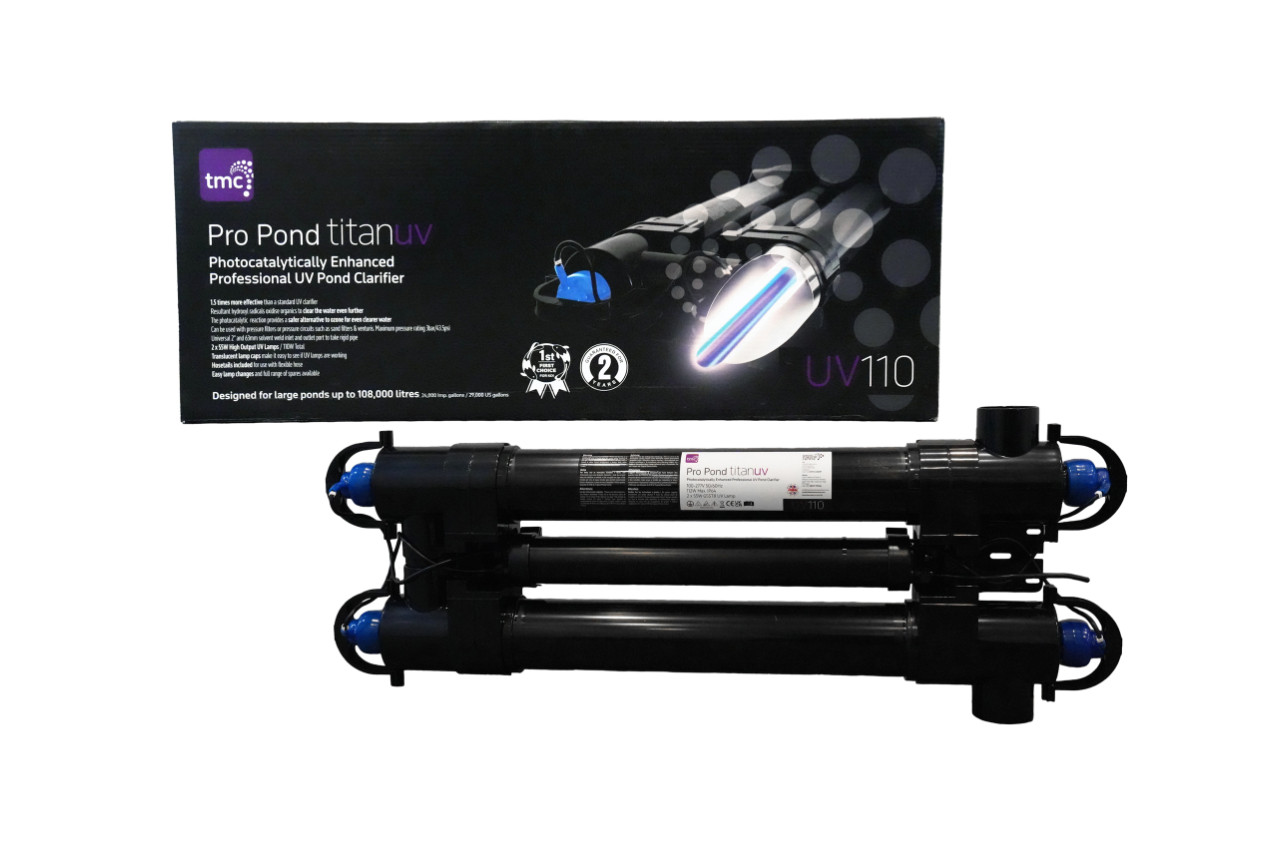
If you've got the green soup, you still need to address the nutrient issue, but you might also consider a UV clarifier. Frankly, none of us here would have a pond without one; they're just about the most effective tool available. The ultraviolet light damages the cellular structure of suspended algae as water passes through the unit, causing the cells to clump together and become large enough for your filter to catch. A properly sized UV clarifier running continuously during green water season will clear up even a heavily affected pond within about a week (and often way less). Make sure you clean them every few weeks and replace the bulb after a year of use. For most of you in North America, you'll really only need your UV during the summer months, and so you could get a couple of years out of each bulb. There is nothing wrong with running the UV for your whole season as long as your weather doesn't freeze it out. UV output degrades significantly over time even when the bulb still appears to be working. TMC has some great, easy to use UV units, like the Pond Advantage and the Pro Clear Ultima. Ask your local fish store or pond place about getting you one.
There are algaecides on the market, and some of them work well in the short term. As a generalization, we would caution you against using them. Large algae die offs can spike your nutrient levels and drop your available oxygen, crashing your pond, and restarting your problem. Oxygen can be at a premium in ponds, especially when the temperatures get upwards of 70.
Barley straw, either in bale form or as a liquid extract, is worth mentioning separately because it works preventatively rather than curatively. It doesn't kill existing algae, but as it breaks down it releases compounds that inhibit new growth. Adding it to your pond in early spring, before algae season kicks off, is a preventative angle worth looking into.
Hopefully what you're coming away with is that like all other captive aquatics, your pond's health requires balance. You're never going to have ZERO algae in your pond and that wouldn't be a healthy system anyway. You want a thin biofilm over everything, and that helps control nutrient spikes and offers natural food for your fish, and small inverts (also food for your fish). Your goal isn't a sterile system, it's a clean, balanced one. Get your nutrient levels in order, provide some shade (perhaps in the way of plants) and honestly just go ahead and add a UV unit, just do it, you are never going to regret doing so. You'll be able to revisit your watery garden, in its shimmering glory and nurse that cup of coffee during the kind of zen moment you built the pond for in the first place.