You're My Fish Blue!
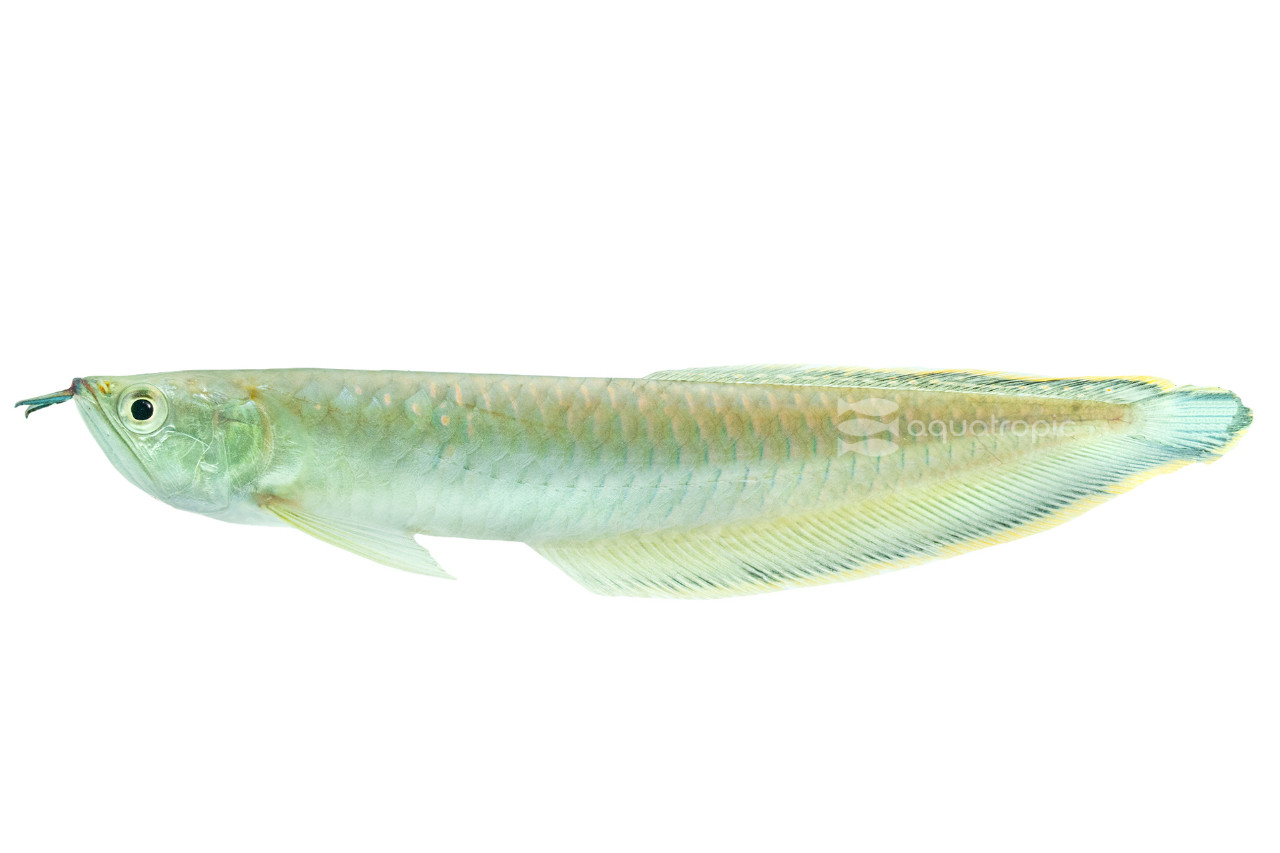
Alexandre Rodrigues Ferreira was the first Brazilian naturalist to explore the Amazon and Pantanal in Para and Mato Grosso. Exploring there, at his time in history, was incredibly dangerous, and has remained so until very recent history. Now you're thinking, hey, wait a minute, I came here to read about fish! Hold your seahorses. We bring up Ferreira because he is the namesake of one of the coolest fish in freshwater: the Blue (or Black) Arowana, known by the scientific name Osteoglossum ferreirai and now you know why.
As you've likely guessed, Blue Arowanas come from South America, and specifically from the Rio Negro, the largest blackwater river in the world, and one of the Amazon's largest tributaries. There are some limited reports of them being collected in different locations. These may or may not be accurate and could also possibly represent introduced populations.
As adults, Blue Arowanas look fairly similar to their close, but more common and famous cousin, the Silver Arowana. Adult Osteoglossum ferreirai will have a blue tinge on them, and a blue/black band on their anal fin that is rimmed in yellow. As youngsters, however, they are easily differentiated. The juvenile Blue Arowana is almost entirely navy blue or black with a golden stripe running down its side and along its pectoral fins. They are both large fish as adults. It isn't uncommon for a Blue Arowana to get three feet long over the course of ten years or so. They might live for 15- 20 if well taken care of and the largest one ever caught was five pounds (the IGFA record!)
Knowing this, it is pretty evident that this fish is going to need a large aquarium as an adult. If you kept it as a single species, you might get away with a 6 foot long 180, but a longer and wider tank would be better, and a tropical pond would really be sweet! This aquarium doesn't need rock or substrate as Arowanas mostly live near the surface of wherever they live and are constantly swimming. You could use smooth driftwood and tall plants as décor, or whatever you wanted really, just make sure that the focus is on open swimming area before cover. Other than size, the next most important aspect of an Arowana display is covering it. These fish have evolved to jump out of the water for food, so they are good at it, and are heavy / strong. When we say to cover this display, we mean it. A foot long Blue can push a standard glass top right off a tank. Bare bottom tanks are popular among keepers of Arowanas because it is easier to remove waste products via filtration and water changes if there isn't any sand or rocks in the way.
On the topic of waste, this is a big fish, with a large appetite, and as such, it takes big dumps. Well, sorry, there's no great way to say it. While Blue Arowanas are easy to keep, and generally very hardy, they can be susceptible to high nitrates and other waste nutrients. You're going to need a big, strong filter, and you aren't going to want to skimp on the water changes. Wild fish will benefit from being kept in water which has chemistry that approximate where the Blue Arowanas come from, soft water that is slightly acidic. They are pretty adaptable fish though, so they can be acclimated to different conditions if done carefully. Both wild caught and aquacultured specimens will need to be kept in water that is between 75 and 85 degrees (which is going to make a pond challenging for most of us in North America.... but not impossible)
What else goes in this huge aquarium, or pond? We've touched on the fact that these fish definitely have the star power to be a single fish display. While Blue Arowanas will loosely congregate in the wild, you'd need several thousand-gallon system to make this work well long term in captivity. Generally, with the exception of other Arowanas, Blues are really quite peaceful and will mostly ignore anything they can't eat, but they'll definitely eat everything they can, so stay away from small fish and inverts unless you want to feed your Arowana expensive meals.
A cheaper way and vastly more nutritious way to feed them would be with Nutramar Freshwater Complete Pellets, which the aquacultured specimens are already eating, and wild ones figure this out quickly as long as you introduce some pellets with some frozen meaty offerings. We also feed them some Gamma (thawed obviously) like Bloodworms, Whole Fish, Whole Mussel, Whole Cockle etc. for when they are large, and smaller offerings like Mini Bloodworms, Brine Plus, Mosquito Larvae, and Mysis when the fish are smaller. At all ages, they will relish live food like earthworms or redworms, or gut loaded feeder fish if you have a reliable and clean source for them. As an aside, this is a really exciting way to feed your Blue, but make sure their base diet is a high-quality pellet, for the nutrient spectrum and the protein density.
There are very few fish in any type of aquarium (yes, including saltwater tanks) that can even come close to the cool of a Blue Arowana. If you plain old need a freshwater monster showstopper in your tank, this is the way. If you have the space and the right tankmates, just do it. Head to your LFS and ask them to get you an Osteoglossum ferreirai from Aquatropic today!