Thinking About Thayeri
In 1865 and 1866 there was a famous expedition into the Amazon for the sake of biological and geological exploration. Over the course of almost a year, a number of scientists (most famously Louis Agassiz and Elizabeth Cabot Agassiz) and a number of other scientists from Harvard collected tens of thousands of fish from the upper Amazon and its tributaries. Many new species were cataloged in the ensuing years from these specimens. This expedition has become commonly known as the Thayer Expedition because a Boston businessman and philanthropist Nathan Thayer Jr funded this mission (among other things over the course of his life). You'll see his name here and there and one of the places you'll see it is in the scientific name Laetacara thayeri, the fish we're here to talk about today.
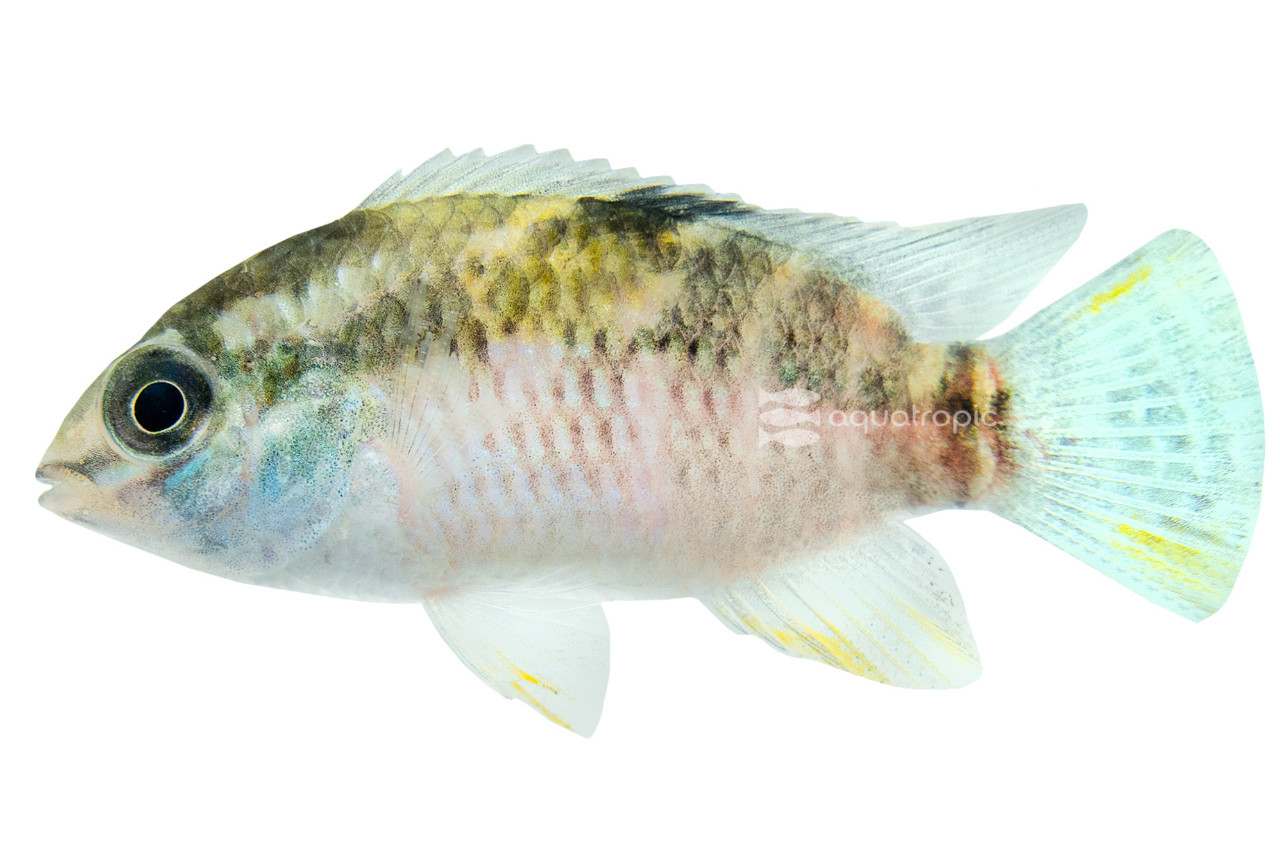
Laetacara thayeri is usually called the Dwarf Acara Cichlid, or Thayer's Dwarf Acara Cichlid, but the order in which those names appear seems to be totally random. As long as it says Laetacara thayeri, they're all the same fish. They're native (predictably) to the upper Amazon and a few of its tributaries. They're a relatively peaceful cichlid that is quite hardy and interesting to watch. The juveniles are a pearly white, with a black band through their eyes, reaching halfway down their body. Like most all the Leatacara, they also have the trademark smile. Adults will retain the pearly colors, but gain golden highlights on their sides and tail, with a pale blue anal fin. Females and males are nearly impossible to tell apart until they get to nearly max size, where males will be a bit bigger, have a stronger flush of color, and have fins that are less rounded than the females.
Dwarf Thayers are kind of a medium sized aquarium fish, they'll get about four or five inches long, the biggest one we know of is likely just a hair over five. In regard to aquarium size, you could keep a group of juveniles or an adult pair in a 55. DTACs grow quickly and will reach their adult size within a year or so; when choosing a display, make sure you future proof it. This aquarium should feature plenty of rocks or driftwood to break up sight lines. Substrate should be sandy or smooth rocks, and don't get too set on any one sand look, because the Thayers are going to do some redecorating. They aren't going to eat plants, but they might dig them up, so plants should be hardy and well affixed to something.
Filtration should be strong and water changes should be regular. While these are generally quite hardy Cichlids, they can be sensitive to high nitrates. Look for filtration that will turn over the whole volume of the tank at least five times and hour and keep up the regular water changes. Thayers aren't picky about water hardness, and pH can be anywhere from the mid fives to the mid sevens. They'll be just fine in blackwater displays, but don't need it by any means. The temperature could be anywhere from the high 60s to the low 80s.
As far as Cichlids go, these are pretty peaceful pets, they're unlikely to bother much else in your tank, unless you have a breeding pair, and those can be territorial. They will establish a dominance heirarchy among each other, and as a result, they'll do better and be healthier if kept in larger groups as this will help distribute any damage that arises through squabbling. If you are choosing to keep a pair, it’s usually better to start with group of at least six anyway as they are basically impossible to tell apart when small. Outside of this same-species aggression, they can be kept in robust community tanks, featuring fish like bigger tetras: Amazon Red Tails or Diamond Tetras would be a bio-type appropriate choices. Armored Catfish, Rainbows, Hatchetfish, Danios, even some of the larger Rams or Corys and Otos could all make good tankmates. Just make sure that the tank is large enough for the other fish in it to get out of the way when breeding time comes around.
Thayer's Dwarf Acara is a really easy fish to feed. They're omnivores and will consume just about anything food shaped that floats past them. Here we use both a meaty mix and the Pellets and Crumbles from Nutramar. As these fish need a good bit of algal content in their diet, we primarily use the Algae and Color Boost Formula. The meaty portion is varied, and on any given day could contain Gamma Brine Plus (Spirulina, Garlic, Omega-3), Daphnia, Bloodworms and Mini Bloodworms, Tubifex, Copepods, Mosquito Larvae and others. A varied diet will have them their healthiest and showing their best colors. They'll also relish live food like Nutramar Artemia, and larger specimens will greedily take live insects and small worms.
If you're interested in breeding these cool little fish, they are relatively rare in home aquariums and so you might have some demand for your offspring! They're pretty likely to breed on their own without much interference as long as you have a fish of each sex. You might want to give them a piece of slate or smooth rock to spawn on. Both parents will care for the eggs and fry but are pretty likely to consume them for the first couple spawns. A change in temperature and an increase in water changes have both been used to trigger spawning.
Here we have a very cool, reasonably sized and mostly peaceful Cichlid that some rarity panache to boot! What's not to love? If you're interested in keeping Nathan Thayer's namesake Cichlid, head to your LFS and ask them to get you six or more Laetacara thayeri from Aquatropic today!