The Ghost in the Darkness
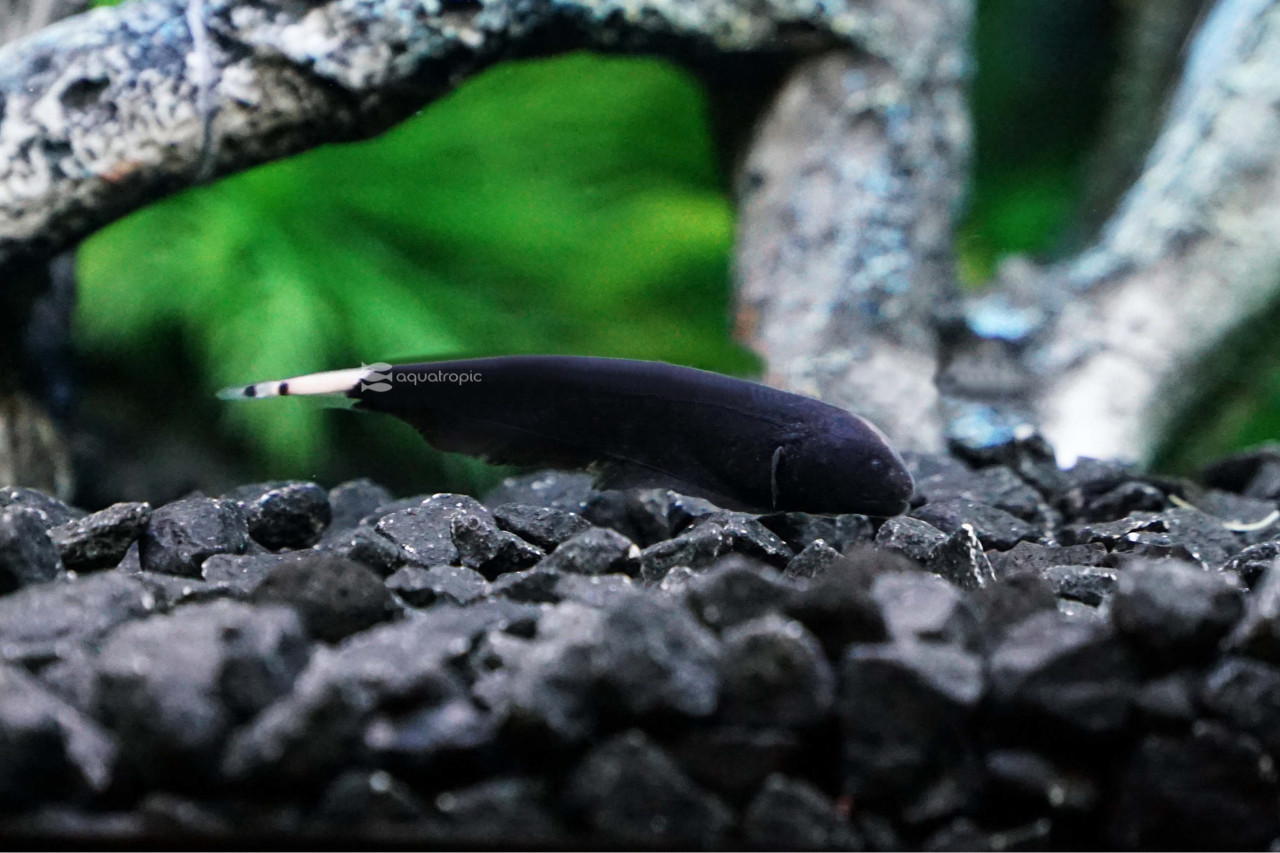
Even the name Ghost Knifefish sounds like something from the imagination of a science fiction author, and once you see the fish, its childhood imagination looks do not disappoint. It's a fish without a dorsal fin, and some knifefish are often without a tail fin, but with an anal fin that runs nearly the entire length of their bodies and is the primary way they swim around. Wait, it gets weirder! They're nearly blind, but also electric.
So obviously, the first question is “Where do I get one?!?” We have a great answer, any Local Fish Store that is an Aquatropic partner can get you Ghost Knifefish, we sell two species of them, Black (Apteronotus alibifrons), and Grey (Apteronotus leptorhynchus) as well as an aquacultured color variation of Apteronotus albifrons called “Golden.” You can see them all, as well as a bunch of other Knifefish here https://www.qualitymarine.com/aquatropic/fish/knifefish/
Your next question is, or at least should be, “How do I keep it?” So, let's delve into that a bit. The elephant in the room is that Black Ghost Knifefish get quite large (for aquarium fish,) in the 15-20-inch-long range, and they aren't extremely flexible, so they need quite a bit of space to turn around. The flip side is that they aren't really all that active either, which helps, but you're still going to need an aquarium that is at least two feet wide (from front to back) and six feet long at full grow out (so worth it). This puts you in the 180-gallon to 240-gallon aquarium range (or more, go big). Brown Ghost Knives have the exact same body shape, but you can expect them to stay much smaller as adults, seven or eight inches is pretty common, up to maybe ten might be expected from a remarkable specimen. This fish could be housed very comfortably in a 75-gallon aquarium long term. Depth (top to bottom) isn't really a concern as long as there is enough volume for the fish.
These aquariums can be planted or decorated just about any way you want to, but you should always offer your Knife a good place to hide (and they'll rest quite a bit during the day, except for feeding times). Many aquarists use PVC tubes for this, which work well, even if they are a bit ugly. The wild habitat for these fish is a fairly neutral pH stream, usually with plenty of cover in the way of wood, and some plants. The water can be stained but certainly doesn't need to be. Both the Brown and the Black Ghost Knife are very adaptable as far as water chemistry goes. The aquarium should be in the 70-to-80-degree range and the nitrates should ideally be kept under 20ppm. Some substrate isn't required, but if you choose to have it, it should be soft and small grained, like a sand bottom stream. Ghost Knives will appreciate a little flow, but this can be over done fairly easily.
Both of these fish are still available to the home hobbyist through Aquatropic partner stores as wild caught specimens, but only the Black (and the gold color variant of it) are being aquacultured on a commercial scale at this time; perhaps there is an opening here for an advanced aquarist who is in need of a new challenge! Perhaps not obviously, the aquacultured specimens are already eating prepared foods. We feed them thawed offerings from Gamma like Bloodworms, Brine Plus, Tubifex, Mosquito Larvae etc. We also feed them the Nutramar Freshwater Complete sinking pellets, a perfect diet for a freshwater carnivore.
Wild caught fish can take a little longer to accept pellet foods but can nearly always quickly be trained to take frozen foods. We earlier referenced these fish being electric. This is not a threat to hobbyists. While Ghost Knives are related to much more dangerous electric fish, they themselves are harmless. Apteronotus genus fish use this electrical current to “see” much like a bat does with sound, and to communicate with other Ghost Knifefish, and also to hunt for small invertebrates, which give off their own weak electrical currents while alive (and is missing from un-alive foods.) It's generally pretty easy to make this food transition, and if you keep offering pellets with the thawed foods, the Ghost Knife fish will figure this out as well.
Apteronotus are generally bug eaters. Their wild diet is almost completely aquatic insects and their larvae, but they also don't turn their noses up at unwary fish that are small enough to fit in their mouths. Conversely, they're super peaceful and could be kept with a wide variety of fish in a community setting. Larger Tetras, Peaceful Cichlids and Catfish, Plecos, even Angelfish would make a cool display! It's difficult to keep more than one Knifefish in a display. The weak electrical field that the fish generates can overlap with the field from other fish and the resulting mishmash is stressful for both fish, which is one of the challenges awaiting the hobbyists attempting to spawn them!
If you're looking for a fish that is the definition of an Oddball, Ghost Knifefish has to be high on that list. They're also quite easy to keep, which just adds to the attraction. The large number of potential aquascapes that could be appropriate for them, and long list of potential tankmates make these fish applicable to an unlimited number of different looking aquariums. Just choose the species that's right for your aquarium size, and start dreaming up your own display. When your tank is ready, always ask your LFS to get your new Ghost Knifefish from Aquatropic.