Happy, Healthy, Hollands!
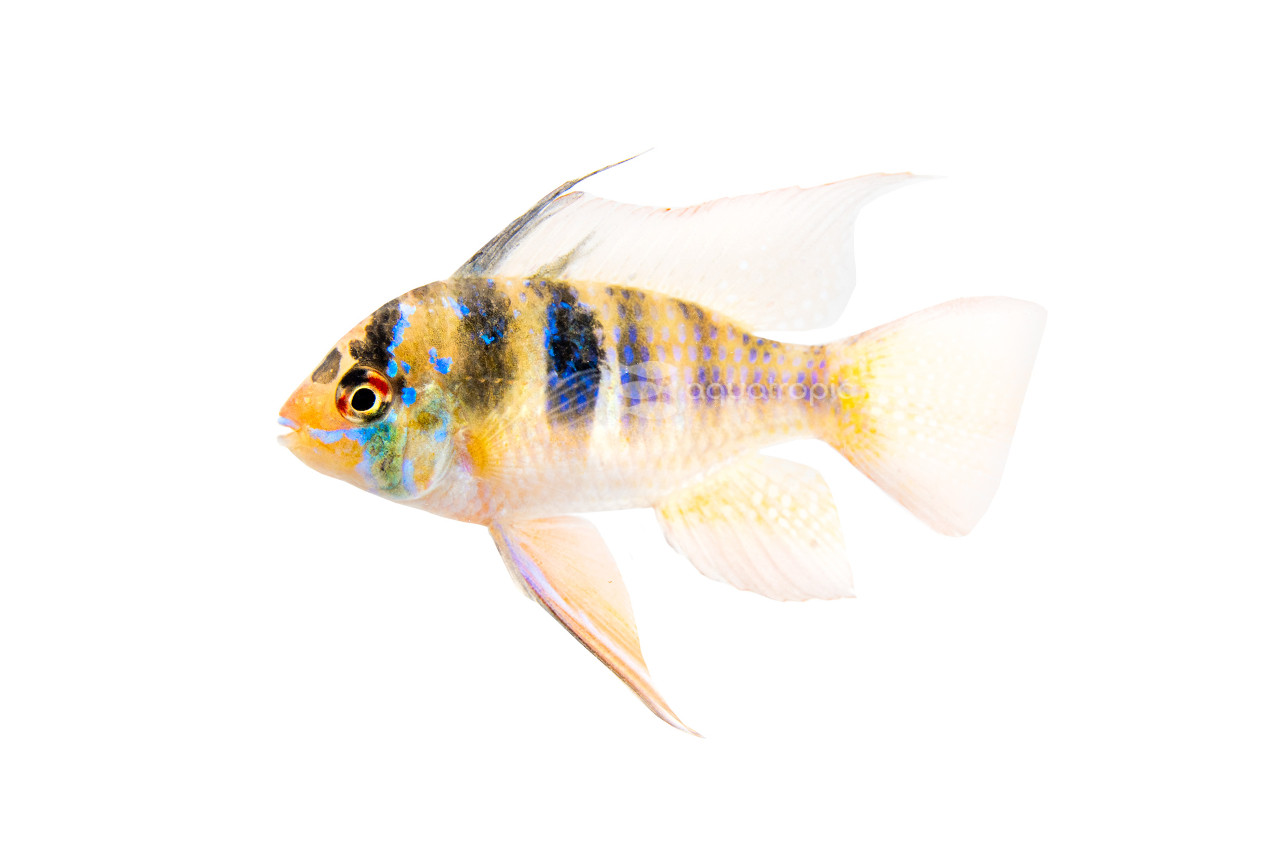
Mikrogeophagus ramirezi is better known as the Ram Cichlid, and less commonly, the Butterfly Cichlid. There are many forms and colors of them, and the most well-known is probably the German Blue Ram. There is another, slightly less well-known variation that goes by the common name “Holland Ram” or “Dutch Ram.” The Holland Ram is one of the most colorful of all the Rams and generally stays slightly larger than the Germans (not all that large of a fish to start with.) There is a somewhat confused history with the scientific naming of this species, and we won't delve too deeply into that, but it is still possible to see them mislabeled as Apistogramma ramirezi, Papiliochromis ramirezi, Geophagus ramirezi and Microgeophagus ramirezi. Will it change again? Who knows.
All the Mikrogeophagus remirezi have the same requirements. If you're here because your fish aren't thriving like you think they could, here is the quick list of answers for you: Raise temp, lower pH and hardness, feed high quality food, use soft sand (and maybe leaf litter to get some micro food working in there), clean up the water via better filtration and consistently doing small water changes. If that answers your questions, we were happy to help. The rest of you read on! Now, after that you may be thinking, oh man, are these fish hard to keep? The answer is no, but they are picky about water temp and will do best in tanks where you pay attention to water chemistry too.
Holland Rams are a small fish, never getting much bigger than two inches long with the largest males maybe reaching a half inch longer. This means you could keep a pair in a tank that was 20 gallons and they could stay in that tank their whole life, but if you wanted to have more of them, you should look into a 40 breeder or a 55 (or more, dream big!) That tank should feature a soft sand substrate as these fish will pick up sand in their mouths and filter through it for food, passing the sand out of their gills and mouth and eating all the little inverts that stay behind. Rocks, driftwood and plants that are attached to décor would all be excellent additions to this display. As mentioned, leaf litter could also be good. Now, it isn't necessarily a need, and you aren't looking to do a stained water display, but well-maintained leaf litter can help foster an environment that naturally produces some microfood which would be great for raising fry, and/or supplemental snacks for your adults.
Really the only challenge to keeping Holland Rams healthy and happy is related to water parameters. Keep nitrates under 20ppm, and lower would be even better. Filtration should be efficient, but flow should be gentle and well diffused to help keep sand in place. That means you're going to need to do regular, small water changes to maintain water quality. Temperatures need to be consistently higher than a lot of tropical fish will love; 79 should be the low you plan for and even up to 84 is good! While Mikrogeophagus ramirezi can live in cooler water than this, they are more likely to have health complications and spawning will be less effective. Next up is pH, which can be anywhere from neutral to quite acidic, and the fish will do best on the more acidic end of this. The range could be anywhere from 4.5 to 7.0, with somewhere in the mid 5's being ideal. Hardness is similar in that the Rams will be okay in moderate hardness but will do best (and have the best success spawning) in softer water, think somewhere in the 20-60ppm range. If you give your Rams this environment, they should thrive.
The rest of Ram care, like feeding, is pretty straightforward. They'll do best on a varied diet fed a couple times a day. We feed them a mix of Gamma frozen foods like Rotifers, Mini-Bloodworms, White Mosquito Larvae, Tubifex, Brine Plus Spirulina, Brine Plus Omega 3. We also utilize a high quality, sinking pellet from Nutramar in both their Freshwater Complete and Algae and Color Boost Formulas. Recently we've started also utilizing the Nutramar Pellets in the Freshwater Complete formula for the Rams and other fish, and if you haven't tried this stuff yet, and your LFS to get you some, it's awesome. Anyway, the more you can mix up their diet, the healthier and more colorful your Holland Rams will be. They'll also relish the opportunity to get live food like Brine and Tubifex.
You can keep Holland Rams with a variety of other fish, and we always suggest keeping them with some dither fish that do well in the same parameters like Rummynose or Cardinal Tetras which will make your Rams substantially bolder. The Rams will mostly stick to the bottom portion of the aquarium, which means they could be mixed with things like Angels and Discus as they both do well in the temperatures and conditions that the Holland Rams thrive in.
Most Mikrogeophagus ramirezi are aquacultured these days, regardless of the different variant you come across. All of the Holland / Dutch Rams are aquacultured, and so they are slightly more adaptable to different water chemistry profiles, but in our experience, you'll still want to stick to what we've outlined to make them the most colorful, active fish you can have. They are relatively easy to keep and even spawn if you give them these conditions. The other upside to being aquacultured is that they are very accustomed to eating pelletized and flake foods. If you're looking for something that's going to add some intense color, activity and interest to the lower reaches of a warm, clean, established aquarium, Holland Rams are a great choice. Ask your LFS about getting you some from Aquatropic and pick up some Nutramar Foods while you're there!