Goody! Good Deeds!
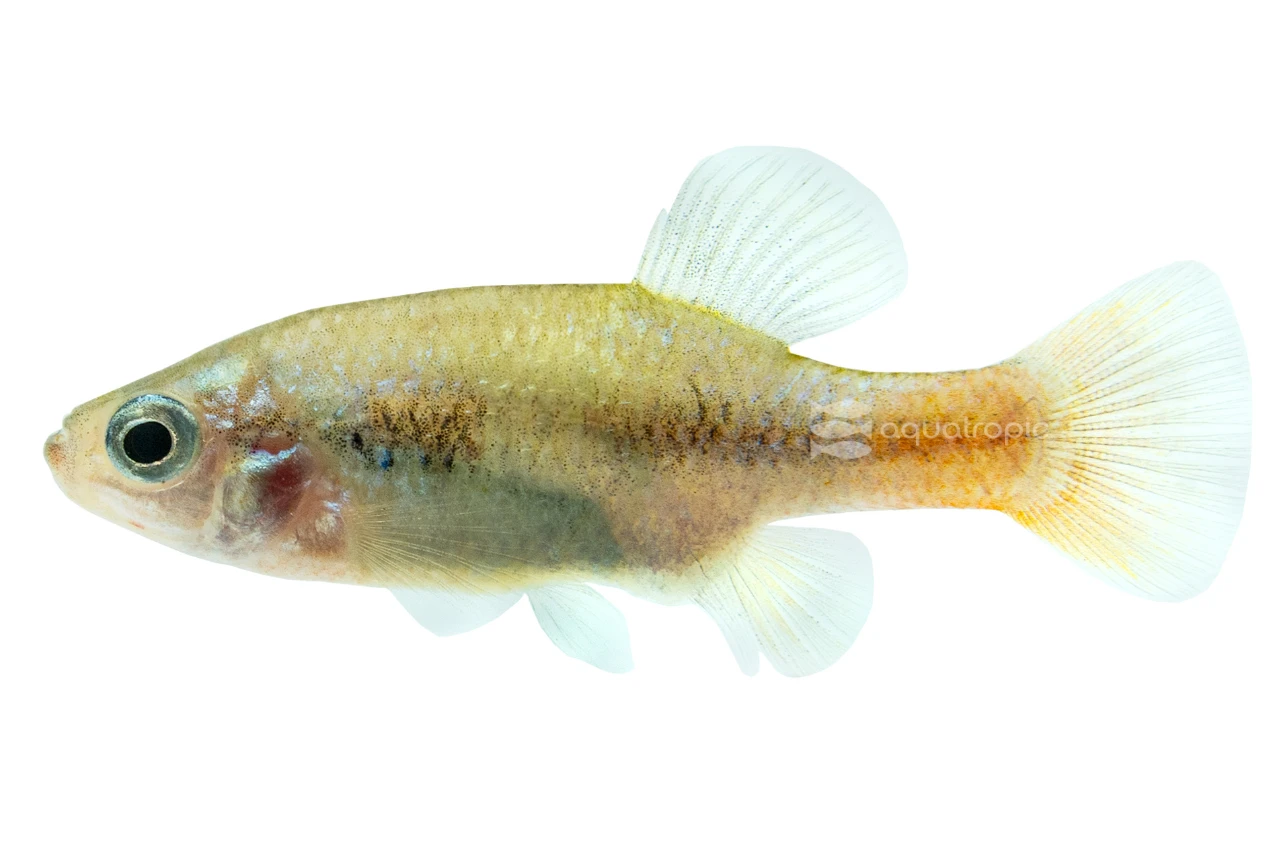
The Redtail Splitfin is an interesting fish, both in the aquarium and in the wild (though pretty much 100% of them in the aquarium trade are aquacultured at this point.) This was once a fish with a small range, only one or two river drainages in Mexico. Human impacts to these environments have made them endangered in their native waters, but they breed quickly, and are quite adaptable to new environments, and can be found in a huge range of locations from pristine spring ponds to roadside ditches all over Mexico. There are at least a few different sub-types of this species, and hybridization between them seems very likely, so perhaps there is a doctorate waiting out there for someone who wants to delve into this more deeply.
These fish are part of a larger group often called Goodeids (or Goodies). This moniker bleeds over into many of their common names like Redtail Splitfin Goodeid, Orangetail Goody, and Red Ear Goodeid. They're easy to keep aquarium fish that also happen to be beautiful. The smaller males develop the trademark red tails and iridescent blue bodies on the back half, while the larger females stay a brownish bronze with clear fins. Some males will develop an orange anal fin, but not all.
Redtail Goodeids aren't that big, with the largest females maxing out around two and a half to two and three quarters of an inch long and the males about a half inch shorter. They like to be kept in groups, and we suggest a bare minimum of five or six, with a better number being 10-12 (though you can keep a breeding pair together by themselves). You could have 10-15 of them in a 40 long, or maybe even a few more in a 55-gallon aquarium. They don't need it, but they seem to love a good bit of water movement in the aquarium. This display should feature dark substrate and driftwood to make their colors really pop and optionally some tough plants like anubias. If you go the plant route, make sure you use a lot of plants. These fish will love the cover and it will keep the males from picking on each other overmuch.
On that topic, we also suggest skewing the ratio in the aquarium slightly to about 60% female (give or take). Red Tail Splitfins are the subject of some animated discussion in house among the aquarists. Some of us will tell you that we've had them in a community tank for a long time with no issue, and others will report ghastly things. There is no doubt that these fish will go after long flowing fins, and are not a good fit for fish that feature them, like Angelfish etc. Redtail Splits have also shown a propensity for going after small catfish like Corydoras which may be a food competition thing (we'll get into that in a bit). The safest way to keep them is as a species-specific tank although many people keep them in mixed community tanks with no issue. Watch them carefully if you go this route and remove any potential victims. Common themes among aquarists that successfully keep Goodeids in mixed species tanks seem to be heavy feeding, lots of cover and higher than average flow; food for thought.
Luckily, these fish are great by themselves and represent one of the easiest live bearers to breed. If you have an adult male and a female that are healthy, well fed and the temperature is between 68 and 76 (or so) they'll make babies repeatedly until the temperature goes above 78 or below 65. They'll go a bit dormant in the lower temps and the higher temps are too stressful for them. Gestation takes roughly two months, and the fry are large but few; a very successful event is still less than 50 babies, so if you get a few, it’s a win. The babies will trail a little umbilical cord looking thing for a few days that is called a trophotaenia that nourishes them. It will fall off or be absorbed in a couple days. The babies are big enough to take powdered food immediately after birth.
In their native habitat Redtail Splitfin Goodeids are omnivores. Their guts and teeth are setup to eat a lot of algae and aufwuchs (living film of mixed stuff that exists on submerged surfaces). Perhaps this is why they are sometimes aggressive to other fish that eat the same material. The diet of the Splitfin should also include some protein focused foods, like Gamma Brine Plus Spirulina and Brine Plus Omega. We also give them some Gamma Tubifex, Cyclops, Daphnia, and less frequently, White Mosquito Larvae and Mini Bloodworms. They're the perfect fish for Nutramar Freshwater Algae and Color Boost Shots. Just stick a shot to the glass or a rock and let them do their natural thing. They're pretty easy to feed and can also just be feed the Nutramar pellets.
Goodeids are good and hobbyists who start keeping them are often obsessed with them. They're pretty adaptable but do best in tanks that are fairly neutral (pH 6-8), and hardness is largely irrelevant unless it is crazy out of whack. If you've been looking for a beautiful fish to build a display around, give the Redtail Splitfin Goodeid strong consideration, you won't be disappointed. As always, tell your LFS that Aquatropic sent you!